

The 1st Marine Advance Force is the ground force component of the Composite Testing Force. 1st MAF is a divisional Marine Air Ground Task Force (MAGTF) of the United States Marine Corps centered around the 6th Marine Division, Fleet Logistics Brigade ONE (Reinforced), and 9th Marine Air Wing (Forward); also attached is Task Force Penitent Calamity, a Joint Special Operations Package Charlie (JSOP-C). The MAGTF was supposed to conduct a mobile, expeditionary littoral-arctic (MELA) major field maneuver in Alaska and the Aleutians as a part of an intercontinental subarctic/arctic joint-combined exercise between NATO and OSATO partners. The ground forces attached were: the USMC’s 1st MAF, the checkily designated Task Force Friendship (8th Amphibious Brigade of the JGSDF’s Amphibious Division (West), the ROKMC’s 9th Marine Brigade, and the ADF’s 18th Brigade under a combined headquarters), the Canadian Army’s Arctic Maneuver Division, the U.S. Army’s 11th Airborne Division (Arctic) reinforced by the 87th Infantry Brigade (Light, Mountain), the Franco-British “Cordiale” Airborne Division, and the Anglo-Dutch-Norwegian North Sea Marine-Arctic Division. These ground maneuvers were to be part of the fourth Exercise Campaign DARCFORCES (Deployment of Arctic Forces) under the name CERTAIN SUNDIAL in conjunction with the United States Navy’s Fleet Problem XXXVI (FLTPRO 36).
The 6th Marine Division is organized as a “Marine Medium Division” under the auspices of Force Design 2050. This means two of its three combat maneuver elements are “Strykerized” infantry mounted in the wheeled Medium Armored Vehicle (MAV), while the third is mounted in the heavyweight tracked Littoral Fighting Vehicle (LFV). The divisional artillery park under the artillery regiment consists of three truck-mounted self-propelled artillery battalions and two truck-mounted multiple launch rocket system battalions, and in this case it is reinforced by a battery of Strategic Long Range Cannons from the U.S. Army’s Coast Artillery Branch. The divisional defense and anti-air battalions provide maneuver air defense to the combat formations, and long-range air defense and strike to the division with a battalion of armored short-range air defense platforms and two battalions of mix-ranged multi-domina interdiction battalions. The medium division is further enabled by a mechanized combat engineer battalion, an armored reconnaissance battalion, and a tank destroyer battalion. The 6th Marine Division has additional attachments, the aforementioned battery of long-range cannons from the Army and a company of heavy armor from the Marine Cavalry Regiment. The MAF’s logistics is provided by a Fleet Logistics Brigade, a joint Navy-Marine Corps (Fleet Force) formation reinforced by a task-organized U.S. Navy Beach Force detachment.
The Medium Division was an improvisational development. Force Design 2040 had originally envisioned a “split track” structure with forward-dispersed light forces (enabled by ultra-light tactical electric vehicles, the Future Vertical Lift family of systems, and watercraft like the Patrol Boat, Littoral) and extremely capable heavy forces (mounted on the LFV and backed by the USMC’s re-acquisition of armor). However, with the dramatic opening states of the war, the Corps was faced with a war that was drastically different than what was originally envisioned, which in turn created an immediate need for a middle-weight force that was more survivable and tactically mobile than their light forces but without the cost or logistical burden of heavy mech. The USMC would adopt a new division structure built around the stop-gap MAV, which was already in inventory and could be produced in greater numbers than the bespoke and very expensive LFV.
One slightly confusing—and very controversial—point of note is that despite being flagged as regiments, the maneuver formations of Marine Divisions are technically categorized as brigades under DOD’s Brigade Reorganization, Interoperability Standardization (BRIST) Initiative in 2033; further complicating matters, Marine regimental combat teams are only type-classified and referred to as brigades once formed. To wit, a marine regiment is a brigade that is only called a brigade once it is task-organized; otherwise, it is a brigade referred to as a regiment. This decision is perhaps one of the single most unpopular elements of Secretary of Defense Cheney’s “Jointening” in the USMC.
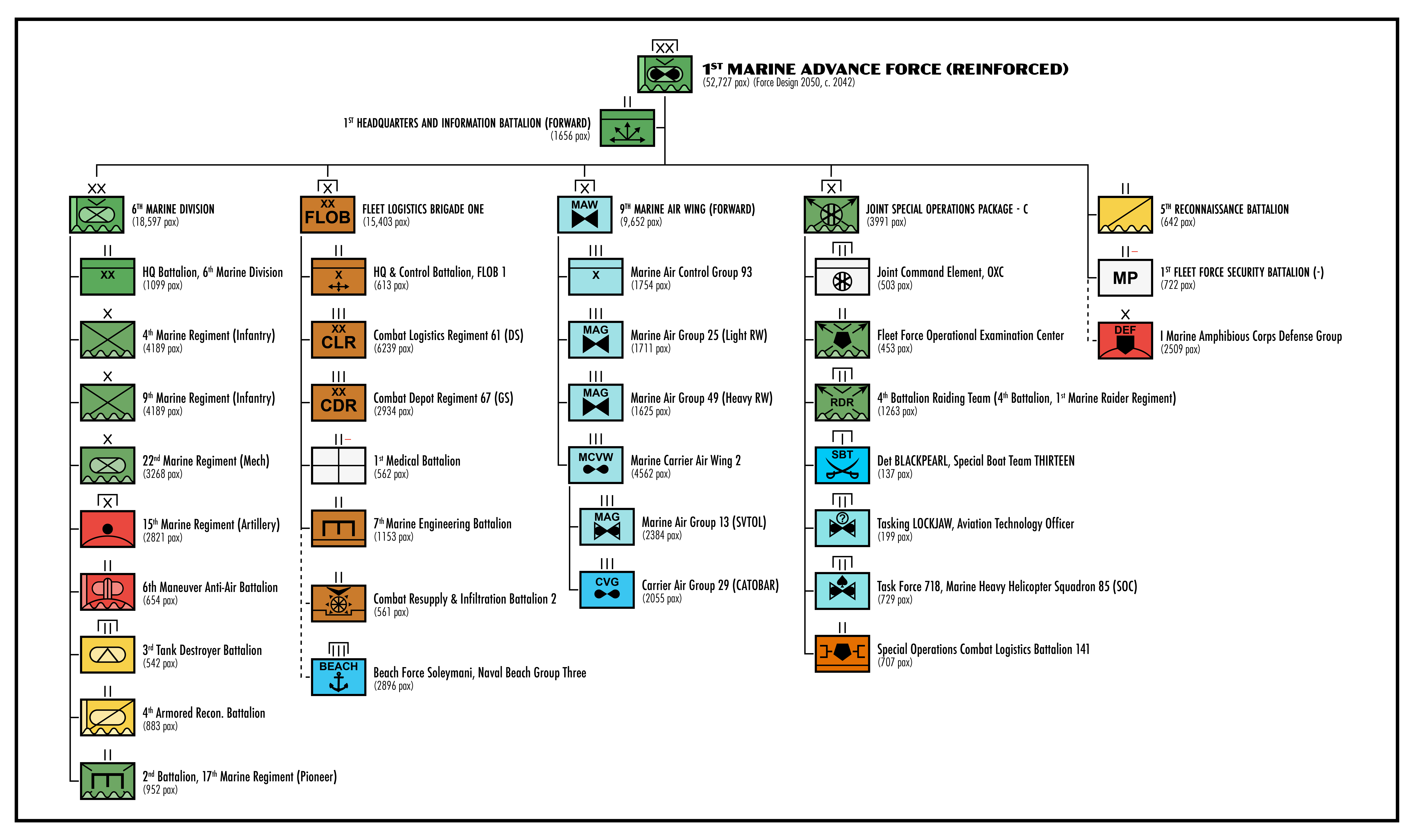
The Advance Force itself is the most recent addition to the Marine Corps family of MAGTFs. It is situated between the Marine Advance Brigade (centered around an infantry brigade with a Marine Air Group for support) and the reconstituted Marine Amphibious Corps (at least two divisions with a full Marine Air Wing). It occupies a position somewhere between the ‘classic’ Marine Expeditionary Force and the Marine Expeditionary Force (Forward), but unlike the old MEF, it is considered a two-star divisional task force, not a three-star maneuver corps. The MAF does have its own Headquarters & Information Battalion supported by an attached Fleet Force Security Battalion (a military police battalion), a Reconnaissance Battalion, and is reinforced with I MAC’s corps-level multi-domain air defense and long strike Defense Group instead of just one Defense Battalion. Completing the MAGTF is a composite Marine Air Wing (Forward) reinforced by a Marine Carrier Air Wing (technically a U.S. Navy formation) and a Joint Special Operations Package, comprised of a Battalion Raiding Team (a Marine Raider battalion task force) and the entirety of the USMC’s Special Mission Unit (this is atypical but not unprecedented).
The New Breed 2: The Newerer
The 6th Marine Division was reestablished on June 8, 2037—about two months into Second Sino—on the State of New Caledonia, assembled from units of the slapdash command Joint Forces South/Melanesia (JFSOME, aka Jiff Some). The new division would reorganize the motley mix of ‘orphan’ Marine units in the area of operations into two newly reconstituted regiments, one infantry and one artillery; it would also retain operational control of the US Army Guard-Reserve’s 184th Infantry Brigade (Light, Urban) and the 1st (NZ) Infantry Brigade. The 4th Marine Regiment was reactivated with the 3rd Battalion, 5th Marines (previously operating as a MAU), the 1st Battalion, 26th Marines (from the West Coast-based reserve 5th Marine Division), and in-situ organized 2nd Battalion, 4th Marines (created from the remnants of the reserve 20th Marine Regiment). While at the same time, 15th Marines took control of 4th Battalion, 11th Marines (a HIMARS wheeled MLRS battalion) and 5th Battalion, 11th Marines (a HIMAGS wheeled SPH battalion).
The situation that 6th MARDIV would find itself in would be described in its official history of the war as “less than ideal.” The first U.S. unit in the region had been the 20th Marines, a reserve interdiction regiment (formerly littoral regiment). While its full strength would eventually be deployed, it was done so in penny packets because of strained air-lift capacity. The 1/20 and 2/23 Battalion Interdiction Teams, 20th Defense Battalion, and 20th Combat Depot Battalion would suffer more than 60% casualties in the first weeks of the war at the hands of the reinforced PLA garrison sortieing from the PLAN’s Buka Passage base complex. The low point of the opening phase would come during Operation PERICLES, a failed attempt to ‘outflank’ Buka Passage anchorage; a reinforced PLANMC battalion would destroy the Australian reserve 11th Brigade and two French Army battalions on the tarmac at Rabaul Airport. These first weeks of fighting were so grim and close-run that the 20th Marines would end up expending every round of STANAG ammo on Guadalcanal and would only win the First Battle of Honiara with their e-tools and two hastily assembled VBIED auto-forklifts ‘procured’ from the island’s Amazon Fulfillment Center. The line, however, would stabilize with the arrival of American, French, New Zealander, and Australian reinforcements. Over the next ten months, Combined Corps, Solomon Islands (COCOSOL)—6th Marine Division, 40th Infantry Division (Guard-Reserve), Division Ouragan, 3rd (Australian) Division—would develop from the Allied Powers’ bloodied southeastern rampart into an unshakable force grinding northward. During this time, the cradle-locked 6th MARDIV would be reinforced with the 9th Marine Regiment (Infantry). 9th Marines was a reserve formation earmarked, under pre-war planning, to reinforce 3rd MARDIV along the First Island Chain. The 15th Marines would also be rapidly filled out with two new artillery battalions formed from a mix of reservists, veteran volunteers, freshly trained cadets, and cadres pulled from other units. The Solomon Islands Campaign would end in March 2038 with the action popularly known as the “Breaking of Buka Passage.” COCOSOL would eviscerate the mostly PLANMC garrison holding the city-sized base complex after five weeks of withering bombardment, including the use of 75% of the U.S. Army’s Coast Artillery Branch’s 12-inch heavy M1865 Strategic Long Range Cannons—the Appomattox Annie. During the battle, just over fifty-thousand 12-inch shells (of all types) would be expended.
After Buka, 6th MARDIV would be almost immediately redirected to reinforce the 1st MARDIV and 25th Infantry Division in the ‘great fencing’ dancing back and forth across Micronesia. This theater was extremely unique in that there was rarely an action at a greater scale than battalion-level. While it is often described as a fencing match, it was closer to a furball. Some weeks would see scores of simultaneous company-sized raids across 2,000 miles. These actions were extremely violent and manpower intensive. With garrisons, raiders, and reinforcements all colliding at close range. It was in this theater that the belligerents would err away from independent USV operation out of fear of having their drone ships boarded and seized.
During the Micronesian fight, an almost depleted 2nd Battalion, 4th Marines would be amalgamated with the Ukrainian Volunteer Battalion. The UVB had been the first ‘foreign legion’ type formation to be activated in Second Sino. The new “Sonyashnyk Battalion” would functionally become an ethnic battalion with a mix of Ukrainian Americans and Ukrainian Nationals (many of whom would naturalize over the course of the war). As the war progressed, the UVB would be succeeded by the full-stength of the Ukrainian 82nd Air Assault Brigade, which ‘volunteered’ and would see hard fighting along the Arunachal Pradesh Front, famously being the “U.S.” element of the Final (27th) Battle of Tawang.
Just before the Liberation of the Marianas in September 2038, 6th MARDIV would be withdrawn to Hawaii for refit and conversion to a type-standardized Marine Medium Division. This would see the new 22nd Marine Regiment (raised in 2037) added to the TO as a heavy ‘tracks’ regiment, and the 4th and 9th Marines converted to medium ‘wheels’ regiments. While on Oahu, there would be further reshuffles. 1/26 Marines, having just completed refitting on Majuro, would be refolded into its parent regiment (at this point, 5th MARDIV was operating in Malaya), as it was in good shape, unlike the rest of the 6th MARDIV. 4th Marines would be reinforced by 3rd Battalion, 1st Marines. The legendary unit—that had been orphaned on Saipan and survived the Marianas Sieges—was chosen as it was to hand, brought to Oahu for refitting. 3/1 and 3/5 would retain their colors despite their continued assignment to the 4th Marines, as their parent regiments had since been brought up to full strength by newly raised 4th Battalions during the intervening year. Similarly, 4/11 and 5/11 Marines would retain their out-of-order colors under the 15th Marine, as 1st MARDIV had been reinforced with a second artillery regiment in its conversion to a new type-standardized Marine Heavy Division. With 1st and 6th MARDIVs refitting, the I Marine Amphibious Corps would break out its colors on Hawaii and, along with it, the I MAC Defense Group to control the MAC’s mixed coterie of Defense Battalions.
6th Marine Division would constitute the second wave of TROPIC FREEDOM, the Liberation of Luzon in April 2039, missing most of the Battle of the Bitulok Valley as the 1st Marine Division smashed through two PAP mechanized security brigades and one PLA combined arms heavy brigade. It would see through the fight for the Manila metroplex before assisting in the regeneration of the Armed Forces of the Philippines. This mix of liquidating holdouts across the country (PLA, PAP, and Dutertista “Blue Shirt” Filipino Enemy Combatants) and training occupied the division until it joined in the Operation ANTIPHON landings in August 2040, as a part of the Liberation of Taiwan, Operation CAUSEWAY.
6th Marine Division would land at Nickelback Beach at Xincheng, making direct and immediate contact with the 74th Group Army holding Hualien City. The landing would be immortalized on camera: an LCAC gliding past a People’s Armed Police affirmative disposition detachment which had been caught unawares by the first wave and surrendered before the death-squad could carry out their summary executions of suspected Taiwanese partisans. The first image of the landing would be a photo of the fire control screen of an LFV-50 showing the PAP officers arguing about the details of their “detail work.” The landings on Taiwan would coincide with the Green Blossom Rising, named after the green armbands worn by the partisans of the Provisional Army of the Republic of Taiwan and the petal graffiti codes of the Taiwanese Organized Resistance. The 74th Group Army would suffer badly from PARoT partisan operations and be poorly disposed to defend against 6th MARDIV, ROKMC’s Korean Expeditionary Force, and the European Volunteer Brigade of the U.S. Army. ANTIPHON had been intended to be a feint to cover the main landings to the north at Keelung and Ludong, Operation CASCADE, but would make unhindered advances into the interior. 74th GA would cease to be an effective fighting force six hours into T+1. On T+2, the future 1st President of the Republic of Taiwan—Freddy Lim—would narrowly avoid death at the hands of a last-ditch PAP-SOF decapitation squad due to the timely intervention of the 1st Battalion, Marine Cavalry Regiment, then attached to 6th MARDIV.1 While most Allied Forces rushed to ‘turn the corner’ and reach Taipei with Operation BOUNDARY, 6th MARDIV would cut across the New Cross-Island Highway (Route 14) in yet another feint (in the process launching the famous Mount Xueshan Raid). Much to their surprise, they found only scattered and disoriented PLA defenses. The division found itself on the wrong side of Taiwan’s spinal mountain range in short order. The division continued and would find itself practically unhindered until it hit the Taiwan Strait. It would be a strategic surprise to both sides of the conflict, unseen since Day Zero and the One Inch Punch.
6th MARDIV would catch three PAP motorized security brigades in their assembly areas along the north bank of the Zhuoshui River. There would be so much burning rubber in the aftermath that the sun was briefly blocked. The division’s many, often brutal, clashes with militarized formations of the People’s Armed Police would earn the division the extra sobriquet “Pig Stickers.” However, in the end, the division would be left exposed, low on ammo, and almost out of fuel, sitting on tank country beyond the edge of Allied supply lines (let alone allocation), having expended a significant portion of its combat power since hitting the beaches. The division’s original ‘reach’ objective had been the Bagua Plateau. Changhua County was mostly agricultural with various recent(ish) industrial developments mixed with continued agglomeration at Xihu and Yuanlin. 6th MARDIV would disperse among PARoT partisans and fight for weeks as a mechanized SIF darting between an unused and incomplete belt of revetments left from the Fall of Taiwan and the county’s varied industrial parks. They would be aided in this by an array of interlinked subterranean structures and tunnels. This was Operation CUFFLINK II—a planning designator—as it had been a theoretical exercise made real by accident. The division would be relieved by the largest Allied airborne operation of the war, but came perilously close to destruction by the closing jaw of PLA reinforcements.2 6th Marine Division had accidentally single-handedly crippled the PLA’s ability to maneuver up Taiwan’s coast and scuppered all existing CMC plans to counter the Combined Pacific Command’s long-anticipated landing operation. The division would be withdrawn back to Puli to refit before joining the final push to take Taichung City when the war ended.
It was a gamble. I expected them to stop, or rather to *be stopped* somewhere around Puli Township—to merely be a threat to the ground lines of communication along the western coast. Not to actually sever them! Those Yankee bastards made my job three times more difficult that week, but ended the war two months early.
— Marshal-General Sakakibara “Tiger” Takahashi, Chief of Staff of the Joint Staff of the Japanese Self-Defense Forces, formerly Commander, Allied Ground Forces, Combined Pacific Command.
After the war, there would be much deliberation about the size, the nature, and even the existence of the USMC. Commandant Faith McPherson would expertly navigate the halls of Congress and ensure the survival of the service, ceding the war-raised 7th Marine Division and 8th Marine Divisions, and the stillborn 9th Marine Division to the Peace Dividend.3 6th MARDIV would come ‘home’ for the first time in mid-2041 and be quartered in the newly constructed Marine Corps Base Fort Stevens as part of Joint Base Columbia (formerly Camp Rilea) on the coast of Oregon; some elements of 1st MAF are based out of the Fallbrook Barracks complex, an expansion to Fleet Force Base Southern California, MCB Camp Pendleton. The division was the natural choice for DARCFORCES and FLTPRO 36 as the West Coast’s northernmost CONUS-based division and the lighter West Coast Marine division (1st MARDIV has three heavy ‘track’ regiments, a full combat engineering regiment, two artillery regiments, and a heavy tank battalion from the Marine Cavalry Regiment).
The General Commanding, 6th Marine Division—Major General Nils Tuomas Nilsen—is a figure who is mysterious, fearsome, and truly bizarre. He known to his Marines as “The Swede.” This is despite the fact that Major General Nilsen is actually Finnish. He cuts a striking figure, a chiseled face with hair that is more salt than pepper and icy blue eyes that could slice through Chobham. However, on a personal level, he is nothing like his cold-cut appearance. He is outright voluble, chatting constantly with his heavy accent, with a kind and affable (and distinctly un-Nordic) bucolic manner that endears him to almost all those around him. He is also famous for “Nilsengrams,” spoken anecdotes that purport to tell a life event that often has little to do with the topic at hand and borders on insane, all with a straight face. No one is certain if they are tall tales or if he is some kind of cryptid. However, his garrulousness can end suddenly and sharply, ushering in a coldly terrifying quiet. His career trajectory is extremely unorthodox; he would join the USMC late in life, after serving in both the Finnish Defense Forces (primarily in the Utti Jaeger Regiment) and then the International Legion for the Defence of Ukraine. He would be sponsored in his emigration to the United States and his commissioning into the USMC by the Central Intelligence Agency after an event in October 2023 outside of Kyiv. The legend goes that Nilsen, on a three-day liberty while his assault unit was refitting, single-handedly saved an Agency junket by killing 19 GRU Spetznaz with a wood-cutting hatchet. He would then exploit this chance to emigrate to the United States, a childhood dream, after attending the Harris Administration’s Ukrainian Force Reconstruction Initiative (a corps-size training effort launched in 2025). During the Second Sino, he would start on the staff of the 6th Marine Division, spending the Solomon Campaign as the division’s G-3 (including planning the Destruction of Buka Passage). He would then command 9th Marine Regiment across Micronesia, where he would earn the Navy Cross for leading a forlorn hope of 2/4 Marines through the Weno Seawall on Chuuk Lagoon. He would then serve as Assistant Division Commander during the Liberation of the Philippines before becoming Commanding General after the CG, Major General Merle Diaz, died in a combined PAP-FEC Blue Shirt ambush on T+2.
When The Swede stops talking. Run.
— I Marine Amphibious Corps saying
Nilsen’s right hand, and the functional commanding general of 6th Marine Division (as the duties of commanding the entire Advance Force consume most of Nilsen’s focus), is Assistant Division Commander Brigadier General Charli Julia Rose. The most combat-decorated trans person in Corps (and American) history, both in and out of the closet. Once, her nickname “The Dame” was a derisive insult, but it has become a term of endearment. She noted for her Lauren Bacall-like husky accent and silver-screen femme fatale affectation. Despite her combat experience, Rose is a merciless and effective administrator. Her ability as a staff officer is paramount to the success of her career, leading to the infamous realization by a Marine Gunner on her staff: “If George Gordon Meade had a rack, that’s what she’s like.” She and Nilsen are perhaps some of the clearest examples of the ‘atypical’ Marines that populate the New Breed, which has taken over the Corps in the wake of Gulf War V and Second Sino.
The 6th Marine was, and remains, a bastard formation stitched together from active, reserve, and newly raised units that forged together in the fires of combat into one of the most storied combat formations in the U.S. Armed Forces. It is an extremely well-armed and highly mobile force that embodies the American Way of War as it exists at the end of the first half of the 21st century: precision, balance, and enough fires to reignite the heart of a dying star.
Four + Nine = Six
The 4th and 9th Marine Regiments are primary maneuver formations and the bulk “bayonet strength” of the 6th Marine Division. They are centered around three fairly traditional “Series P, Light” infantry battalions. The special sauce is the addition of a dedicated Medium Amphibian Battalion, which provides each battalion a company of Medium Armored Vehicles for tactical and operational mobility. In keeping with Marine traditions for flexibility, each infantry regiment has a “chuck battalion” that is cross-trained for air assault or boat landing; this battalion, when mounted on ‘wheels,’ rides on MAV-L variants in the Amphibian Battalion’s logistics company, instead of the MAV-35 variants like the other infantry battalions.
The Series P, Light battalions are built around a 14-Marine squad—with a SL, an ASL who is also trained as a CSFO2 (Comms-Systems-Fires Observer/Operator or Sifu), and three fire teams of 4. The squad Sifu (a senior sergeant) primarily functions as a Joint Fires Observer, communications relay, and pointman for the squad’s SMETT robotic beasts of burden.
The standard arm of the USMC is the marmite M33 Marine Individual Service Rifle, called by the name Misery. The rifle is a derivative of the Colt RM-223-AR bullpup—a derivative of the True Velocity RM-277-AR—chambered in OSATO’s neckless 5.6x41-millimeter-P cartridge. It is produced by the New Colt Arms Consortium, leveraging the ‘Rock Island Magic’ combination of True Velocity’s steel-base composite-polymer cased ammo and piezoelectrothermal-chemical (PTC) controlled plasma-ignition primers.4 Two fire teams are equipped with the lightweight 40-millimeter B&T break-open M406 Support Individual Grenade Launcher, often set up as a braced pistol and capable of firing precision-guided or gyrojet-assisted munitions. The third fire team is equipped with a Barrett 30x42-millimeter M407 Precision Individual Grenadier System, a pump-action grenade launcher-shotgun designed to engage emplacements, bunkers, and S-UAS with ‘smart’ fused rounds, along with a secondary breaching role.
Each rifle platoon has three rifle squads and a weapons squad. The weapons squad contains a squad leader, CSFO2, and three gun teams of 3 Marines equipped with either the SIG Sauer 6.8-millimeter M250 Squad Automatic Weapon or 8.6-millimeter Colt M260 Lightweight Medium Machine Gun. Each weapons squad has four M250s to permit a 4-by-2 configuration, while the company retains a total of six M260s in its armory to be deployed as needed. The platoon HQ then includes the platoon leader, platoon sergeant, a corpsman, a senior “caller” Sifu (with a focus on fire coordination rather than systems) to assists the PSG with fires, and a junior ‘droneman’ Sifu (with a S-UAS) to provide the PL more situation awareness.
The rifle company is comprised of three rifle platoons and one weapons platoon. The weapon’s platoon includes: a UAS section with medium range S-UAS, a mortar section with a lightweight carbon-composite 60-millimeter multi-purpose mortar launcher (a traditional mortar that is also capable of projecting loitering munitions), an offensive UAS section with striking and intercepting drones, and a launcher section with a mix of 84-millimeter recoilless rifles and multi-role Individual Multi-Purpose Launchers (common CLU capable of firing STANAG/MIL-STD compliant man-portable anti-aircraft and anti-tank missiles). The rifle company HQ includes the commanding officer, executive officer, gunnery sergeant, first sergeant, two supply sergeants, two CSFO2s, and a senior corpsman.
The infantry battalion has three rifle companies and a weapon company. The weapons company includes: a heavy automatic weapons platoon with heavy machine guns and automatic grenade launchers, mounted on up-armored derivatives of the Infantry Squad Vehicle; a scout platoon, also mounted on an enclosed cabin, armored derivative of the ISV; an electronic warfare platoon, including three tactical and one area support teams; a heavy UAS platoon; and a mortar platoon with nine 120-millimeter automatic mortars mounted on uncrewed derivatives of the Infantry Squad Vehicles. The battalion is led by a headquarters and headquarters company and is logistically supported by a forward service company detached from the regiment’s assigned combat logistics battalion.
The ingredient that makes the Medium Regiment actually “medium” is—shockingly—the Medium Armored Vehicle. Keeping with Marine traditions, MAVs are not organic to the infantry battalion; a Medium Amphibian Battalion is OPCONed to the infantry regiment, which then provides an MAV company to lift each maneuver battalion. This notionally permits the regiment to seamlessly transition to legging it ‘feet dry, feet wet, feet sky’ (ie, legging it on foot, deployment by US Navy fast attack craft, or insert by rotorcraft). This also means MAVs can more easily operate independently after the infantry dismounts—as a screening, quick reaction, or direct fire support element.
MAV has an exceedingly crisscrossed history, as it is actually the Corps’ adoption of the Army’s M1414 Stryker Bulldog, which itself was derived from the Marine Corps’ Advanced Reconnaissance Vehicle (Increment III, Block IIA). The USMC would find itself dissatisfied by the performance of the Amphibious Combat Vehicle family in First Sino and sought a replacement with its post-war budgetary influx in hand. The Marine Corps “could finally afford to spend on the heavy,” in the words of the then-Commandant. This would lead to a combined US-JPN-ROK-PHL adoption of the KAAV-II (as the Littoral Fighting Vehicle (LFV) in U.S. service); Hanhwa beat out MHI’s Mitsubishi Amphibious Vehicle, American Rheinmetall’s Sea Tiger, the Turkish Alpha ZAHA, and GDLS’s Common Amphibious Vehicle (which actually would not be related to the MAV). Delays to the LFV program and the decimation of the ACV fleet during the Fifth Gulf War’s nuclear exchange would lead the USMC to procure the Army’s ‘upgraded’ Stryker as a quick and dirty stopgap. They would then acquire over 2,500 ‘stopgap’ MAVs over the course of Second Sino.
The base variant of the platform is the MAV-35, which is armed with a lightweight electrothermal-chemical (ETC) M1117 revolver cannon, chambered in 35x123mmE, a ‘Supershot’ version of the venerable 25x137mm Bushmaster round, along with two BGM-191 CCMS-H anti-tank missile in Agnostic Missile Cells (capable of launching most light STANAG ground-based guided weapons), and a co-axial 8.6mm medium machine gun. It designed to carry 11 dismounts with 2 crew. Its increased seating capacity is thanks to its extremely energy-dense hybrid powerpack, which leverages solid-state batteries with a near-adiabatic dimethyl ether-fuel opposed piston engine. 35-millimeter Supershot was adopted as a new common cartridge for medium AFVs, CIWS/CRAM, and fixed-wing aircraft in the “commonalitymaxxing” era of The Jointening.
The battalion is comprised of four maneuver elements: two battalion lift companies, one regimental cannon company, and one battalion logistics company. The battalion lift company is intended to lift an infantry battalion. It consists of a company HQ; a battalion support platoon to lift the infantry battalion’s headquarters (2 MAV-C command posts, 6 MAV-L cargo vehicles, and 4 MAV-AMB evacuation vehicles); three rifle lift platoons to lift the rifle companies (24 MAV-35, four sections of 6 MAV-35); one weapons lift platoon to lift the dismounted weapons company elements (6 MAV-U drone carriers, 6 MAV-EW electronic warfare vehicles, and 6 MAV-L/M mortar team carriers); and one heavy mortar platoon (4 MAV-M mortar vehicles with the 120-millimeter NEMO automatic mortar and 2 MAV-C/FD fire direction vehicles). The battalion logistics company is the same as a battalion lift company except it is equipped with LAV-Ls with the “short 30” M230LF on a Super CROWS remote weapon station and does not have a mortar platoon. The regimental cannon company contains two breach platoons (3 LAV-50/E armed with M913 50x228mmE chain guns and 2 LAV-120/E armed with M291 ETC 120-millimeter high velocity smooth-bore cannons; both variants have integral MCLIC launchers and dozer blades) and a regimental support platoon to lift the regimental headquarters (6 LAV-C in one section and 12 LAV-L in two sections). Finally, the battalion is sustained by a forward support company from its parent infantry regiment’s CLB.
The Commanding Officer of the 4th Marine Regiment is Colonel Oliver Orenthal James South. He is known variously as Olly, O.J., or Juice, despite hating all monikers but his given name. South spent the majority of his career in career in administrative and advisory positions, spending over a decade bouncing between the National Security Council and the Osaka Council from 2024 to 2036, after a respectable but not otherwise notable career in the field as an electronic warfare officer. He would be flung headlong into combat during Second Sino. He would be flying out of Tokyo for an overdue vacation ahead of a long-planned retirement when the missiles started flying; his flight would be diverted to Honiara, where South would be the first Allied reinforcement to the island—in flip-flops and a Hawaiian shirt. He then served in various official and unofficial capacities during the swirling knife fights of the first weeks of the war, at some points leading infantry actions as small as platoon-level while technically just a corps-level EW officer for the newly formed JFSM staff. There is a legend that he killed the PLA assault force’s commanding officer in hand-to-hand combat in a monsoon. This is a myth, as to his recollection, he lost the only hand-to-hand action he fought (getting his lights punched out by a PLAAF SNCO who was then deleted by a 30mm PIGS buckshot round). He would briefly lead the 4th Marine Regiment from its reestablishment until his promotion to division G-3 (replacing Nils Nilsen); he would take up the command of the 4th Marines again in 2038 after its CO was relieved of command due to a stress induced breakdown, he would then promote up again to divisional Chief of Staff before taking up command of the 4th Marines for a final time when its CO was killed in a traffic collision on Taiwan. He would be preparing to retire and pass command off to Lieutenant Colonel Hanson when 6th MARDIV was chosen for the FLTPRO. Hanson would be frocked as a full-bird, but the change of command ceremony would be punted until after the FTX because of Hanson's demand for “one last game with the boys.”
When I first saw Major Hanson, she had just come back from a trench raid—I had never heard of a field-grade officer leading something like that. She made a point of putting herself in harm’s way to show that she was no Dugout Doug. Morale on Saipan was a delicate thing. Like everything else, it was in short supply and always on the brink of collapse. She was caked in what I first thought was mud, but on closer inspection, it was blood—and not hers. Her eyes burned like two smoldering coals set in the blackened lifeblood of God knows how many Chinese soldiers. Her hands wrapped around a bent, near-broken trench club. I realized then and there why they called her Red Monica and why I’d never call her anything else.
— Shannon Immamura, CNN War Correspondent, on meeting Major Monica Hanson (Acting Commanding Officer, 3/1 Battalion Landing Team) on her second day on Saipan, c. 2037
Hell’s Herd—3rd Battalion of the 1st Marine Regiment—is perhaps the most famous formation of the United States Marine Corps to fight in the Second Sino-American War for its daring stand alongside the “2/294th Marines” (2nd Battalion of the 294th Marianas Infantry Regiment, Army Guard-Reserves) on Saipan. They are still led by Colonel Monica Anne Hanson, as they have been since the first day of the war. Then-Major Hanson, the battalion S-3, was thrust into command after the death of every officer her senior on Saipan. Since that fateful night, she has become the embodiment of the New Breed—a Battle Dyke, in her own words. She has since earned a litany of other monikers: the Satan of Saipan, the Banshee of Mindanao, the Lady of Hell’s Herd, and—most famously and simply—Red Monica. Hanson is a war hero and social media darling, considered by some to be the literal reincarnation of Chesty Puller (which led to a petition for her to assume command of 7th Marines, which she rejected on an Instagram stream). Still sporting her buzzed ruby red hair, she is the most decorated Marine in the Corps’ history. She has warded off several attempts to “take her boys away from her” (ie, promotion) and was content as an “extremely terminal O-5.” She would finally be convinced by South to take over the regiment in late 2041 so that the long beleaguered O-6 could retire in peace. The 3/1 would survive Saipan, just barely. It would see hard fighting in Luzon and would be detached for independent service to support U.S. Army operations on Mindanao, before eventually slugging it out in Taiwan. 3/1 Marines is still considered the most battle-hardened unit in the Corps, with a grueling home-brew training regime and quietly very selective, below-the-table standards for selecting new NCOs and officers. For this reason, more than 35% of its officers and enlisted are post-amputees with combat-grade bionics. There are, in fact, some concerns in HQMC that the unit might be too tight-knit and could be “a command liability” (part of the reason why Hanson was forcibly pushed upwards, as relieving her was not politically tenable).
Whether for 294 days or ‘till the end of days. The Marianas hold.
— Major Monica Hanson (Acting Commanding Officer, 3/1 Battalion Landing Team/Joint Forces Saipan) recorded video statement posted on Instagram, c. 2037
The 2nd Battalion of the 4th Marine Regiment, the Sunflower Battalion, is a unique formation that is somewhat in legal limbo since the end of Second Sino. The story of the Foreign Armed Volunteer Formations of the United States Armed Forces is extremely complicated, hotly debated, and legally in flux in 2042. Many in DC wished to eschew foreign formations altogether and reject foreign volunteers entirely, some wished to integrate foreign volunteers directly into existing formations, while others supported the creation of an American Foreign Legion. The end result would be a hybrid of options (2) and (3), with many volunteers being pushed into the ‘normal’ pipeline, but certain influxes would lead to the creation of Foreign Armed Volunteer Formations within the Army and the Marine Corps. The largest formations would include the “Kharkiv Brigade” (formally the Ukrainian Volunteer Brigade, formerly the 82nd Air Assault Brigade) from the Republic of Ukraine, the “Dar es Selaam Brigade” from the Federation of Tanzania, the “Ghosh Brigade” (Arabian Volunteer Brigade) from the Plurinational Union of Arabia, and the "Garibaldi Corps” (European Volunteer Brigades) from the European Union.5 Though 2/4 Marines’ proud lineage is often overshadowed by its recent FAVF status, it retains its traditions—both from the China Marines and new ones formed in the early phases of Second Sino before it became a FAVF unit. The latter category includes the unit’s recent and somewhat confusing battle-cry, “REMEMBER THE TWENTIETH! BAYONETS!” This is oft mistaken as a reference to the Army’s 20th Maine at Gettysburg instead of the 20th Marines on Guadalcanal. The battalion is currently led by Lieutenant Colonel Oleksandr Semenovych Kravchenko, a retired 9-0 MMA fighter and veteran of every stage of the Russo-Ukrainian Wars from 2014 to 2026. Known as “Krabman” to his English-speaking subordinates, he is outwardly a strict, disciplinarian, and humorless man, but that is primarily an affectation he has used to curry prestige and legitimacy as a foreign officer within the USMC. He may be a 6’4” and 255-pound brick shithouse, but he is far from a meathead, having earned a Doctorate in Ornithology from LSU (and permanent residence in the United States) during his time out of uniform. He would be a key booster in the Ukrainian Volunteer Organization, which would lead to the Volunteer Battalion; he would serve as the Volunteer Battalion’s XO at its creation and would continue when it was amalgamated with 2/4 Marines before being promoted to battalion commander in 2040. The battalion is famous for nigh-reckless aggression and heavy-handed assault tactics. There is a joke that 2/4 teaches its Marines to hurl demolition charges before they learn how to shoot. For this reason, they are considered the best assault infantry in the U.S. Armed Forces, and it cannot be disputed that they made breaching Micronesian sea walls into an art form.
So Hill 238, ‘bout a company of us had been hurled in on Osag’s before Chucky shuffled air assets in from Vietnam and Hainan, s-so the other inserts were scrapped. We could see the lights of Quezon City and were dropping fire from the Fleet and our Red Legs. We used passive direct electro-optical observation, not just the usual mesh of Mavics to keep the data flowing cus the EW was so bad. The PLA came at us—a slap-dash battalion like two companies of reservists and a company of regulars—hoping to get us off that hill and give time for their main body to regroup. We slagged their vicks with IMPs, but the infantry kept closing. One of the reservist companies we mulched at 500 yards. God bless electro-fiddy and 40-mike bolters. The fuckers thought they had cover when they didn’t even have concealment. They dropped arty on us, but the Big Man never took cover. He stood up on the crest of that hill like an angry brick wall. Chucky fixed fucking bayonets and came up through their own goddamn arty. Musta had a gunjy CO of their own. We threw them back down and turned them into brisket. I saw Krabman kick—kick!—a Chi-Com NCO down the slope, no cap. I mean, what more can I say? Ukes are just built different, man.
— Gunnery Sergeant Anderson Jones (Platoon Sergeant, 1st Platoon, Charlie Company, 1st Reconnaissance Battalion) on Major Oleksandr Kravchenko (Executive Officer, 2nd Battalion, 4th Marine Regiment), c. 2039
The 3rd Battalion of the 5th Marine Regiment is yet another distinguished battalion. It is the Darkhorse that stood alone in the breach, holding back the night. It would famously fight almost alone for three weeks on Guadalcanal after the 20th Marines was rendered combat ineffective and before the arrival of the reservists of 1/26 Marines at the peak of the initial PLA effort to secure Henderson Field. Another way the battalion is like its half-sister battalion 3/1 Marines is that it is also under the command of a ‘certified old hand.’ Lieutenant Colonel Burt “Atomic” Housatonic would come to command the battalion starting in 2038 after transferring up from 4th Battalion, 11th Marines, where he was serving as executive officer. He is a short, swole Marine with a chevron mustache and a moderate case of male-pattern baldness. He is an outspoken and aggressive field commander who has a keen appreciation for heavy, massed fires. He is famous for standing in the middle of Route 14 under a hail of machine gun fire to knock out a PLA pillbox that was holding up the entire division at the start of CUFFLINK II with a single round of Gryojet 40mm from a SINGL pistol. The Battalion, like Houastonic, has discipline like cold iron and esprit de corps like a raging fire.
Finally, the maneuver support battalion attached to the 4th Marine Regiment is the 6th Medium Amphibian Battalion—Screaming Dragons. It was formed in situ on Guadalcanal from a mix of detachments from the active duty 1st Assault Amphibian Battalion and the 3rd Mobile Reconnaissance Battalion, and the reserve 5th AABn. It would start and remain an ACV-dominant formation until the middle of 2038, when attrition would force it to convert entirely to MAVs. Like the rest of the old hands in the China Marines, it is commanded by a veteran officer, Lieutenant Colonel Daniel Arkansas, who is reported to be the most boring man in the Division; he originally took command of the formation as a major in 2038 after the previous CO died in a car accident while drunk driving on Oahu. This incident has resulted in the“Drunken Dragons” becoming the go-to insult for the unit.
The 9th Marine Regiment (Striking Ninth) is banally conventional compared to the extremely atypical 4th Marine Regiment. The regiment would be reformed in 2030 as a reserve designated to reinforce the III Marine Interdiction Force in the event of a general war across the Pacific Rim. The regiment would be called up for active duty at the outset of hostilities, but there would be much consternation about what to do with them. They would be moved to Hawaii to serve as a general reserve for Allied Ground Forces (and to allow the regiment to knock the rust off), before being surged to relieve and reinforce the 6th Marine Division. The current commanding officer of the 9th Marines is Colonel Brynlyn Galilee Anderson, who is best described as a peach-haired Mormon horse girl with silver eagles on her lapels and the heart of Genghis Khan in her chest. She would assume command of the 4th Armored Reconnaissance Battalion in late 2037 after serving as an armored recon company commander in the early Micronesia campaign’s game of parry and riposte. She would distinguish herself at Buka Passage, earning a Silver Star Medal, a Bronze Star Medal with “V” Device, two Purple Hearts within 36 hours while leading the division’s ‘provisional fast reaction force.’ Anderson would assume command of the regiment ahead of the invasion of Taiwan, as it became one of the most fearsome in the Corps. She is also the last American officer to lead a horse cavalry unit in combat, having led a mixed force of Marines and PARoT partisans on a trek up into the Xueshan Mountains to destroy the PLA’s main communications hub on Mount Xueshan, for which she was awarded the Navy Cross. The regiment, along with the other previously reserve elements of the 6th Marine Division, would be formally converted to active duty units at the conclusion of Second Sino.
First Battalion of the Ninth Marines is still known as the Walking Dead and would re-earn that sobriquet after a series of bruising battles against the PLA at Buka Passage (where they were the lead breaching element), Quezon City (where they lost nearly half its strength fighting off two PLA/PAP combined brigades attempting to break out of the cordon around the city), and at Beidou (where two of its companies held off a PLA armored brigade for 36 hours during CUFFLINK II). They are commanded by Lieutenant Colonel Paul Jenkins “P.J.” Mak, a Cantonese-American former MLB player, rocket scientist, and astronaut, who pitched for the Pirates before being the 7th American to return to the moon on Artemis V in 2030. The battalion is considered able but unlucky.
Second Battalion of the Ninth Marines—The Hell-met—would have the distinction of raising the Taiwan Independence Flag, the Formosa Tiger Flag, and the Republic of China Flag (as no one was certain which would be most appropriate because different partisan groups used different flags) over Hualien City during CAUSEWAY. The battalion would also see service performing humanitarian support operations during the Fifth Gulf War after the nuclear exchange. The Battalion’s newer double pun nickname is a product of their current CO (who is also the battalion’s previous XO), Caden Jayson Kowalski. Kowalski is perhaps the most vulgar officer in the Marine Corps, having infamously spewed a flurry of extremely niche slurs (allegedly used by a Tibetan youth criminal organization with little to no online presence) at a Hungarian news crew while on liberty in Brisbane. He is tolerated because is more than capable of ingratiating himself to his superiors and his men; however, he is still only ever tolerated, never quite beloved. The battalion is considered a nest of douche-canoes.
Hey shitass, don’t forget I know more slurs than you know letters! [Redacted] [Redacted] [Redacted] [Redacted] [Redacted] [Redacted] [Redacted] and your sister too!
— Lieutenant Colonel Caden J. Kowalski, (Executive Officer, 2nd Battalion, 9th Marines) to an RTL Hungary News Crew in Brisbane, Republic of Australia, c. 2038
The Third Battalion of the Ninth Marines—the Shadow Warriors—is primarily famous for generating its own subculture of “Goth Marines.” This would lead to a protracted legal case regarding grooming standards, religious freedom, and self-expression, which would eventually permit Marines to wear face paint or powder while quartered and out of combat. The subculture would start as a bit between shit-faced enlisted, get picked up by some officers as a ‘fun’ morale booster/team-building exercise (it would be neither), and remain somewhat controversial and divisive among the unit. Mostly, some old fuds who think it’s gay (because they didn’t listen to MCR growing up) and young guns who believe it’s cringe. Their CO is Jerold Hymes, a mild-mannered Minnesotan father of four, who is polite, generous, and maybe a little bit too old to still be that into My Chemical Romance. One of the earlier proponents of the battalion’s new aesthetic, he would lead a series of daring trench raids at Buka Passage as a company commander, allegedly killing thirty men with a garden trowel that he had brought from home (this is likely apocrypha). He would be awarded the Silver Star Medal for leading no less than seven forlorn hopes on Palau, where he would be wounded grievously, losing half of his left leg and most of his rib cage. He would rejoin the battalion on Taiwan as Executive Officer before taking command in 2041.
The 9th Medium Amphibian Battalion—Mighty Nine—is the 9th Marine Regiment’s official ride-share provider. Force Design 2050 originally planned for all MAV units to be realigned to numerically match their parent regiment, but this has not happened for various administrative reasons; it was even being mooted pre-Departure that the units should just become the “Amphibian Battalion, [parent] Marine Regiment.” 9th MAB matches its parent formation as it is a war-raised unit, formed in 2037 once the USMC adopted its overall force objective but would not join the division until its refitting in Hawaii. It would see particularly heavy fighting around the Zhuoshui River, inflicting massive casualties on PAP formations before itself suffering badly at the hands of cross-strait PLA rocket fire. It is commanded by Lieutenant Colonel Dan Scrap, a meticulous alcoholic and celebrity DJ in Chile; his younger brother, Mike, is the commander of one of the division’s artillery battalions, 2/15 Marines. He and LtCol Arkansas are known as “the Dan Dans.” Though the pair are not particularly close—they merely pretend to be buddies due to peer pressure and social expectations that rose about them over the last two years.
Double Double Boil in Trouble
The 22nd Marine Regiment is the case-hardened steel-plate fist of the 6th Marine Division, a heavyweight punch unavailable to previous generations of Marines. It is a true mechanized formation with the operational and tactical mobility to match. The regiment is formed around three “Series P, Heavy” battalions, which have fewer dismounted enablers than other Series P battalions but are organically mechanized at the battalion level. These units are heavy formations intended to go toe-to-toe with the best and heaviest hostile peer formations in their own right thanks to the regiment’s hundred-twenty-odd Littoral Fighting Vehicles.
The “Series P, Heavy” battalions operate on the same base fourteen-Marine squad structure as the rest of Series P formations, but without a weapons platoon in the rifle company, as supporting direct fire is to be provided by the 50-millimeter chain guns and ATGMs on the platoon’s attached tracks. The rifle platoon compensates with a reinforced weapons squad with 5 three-man teams. Generally, the teams are divided into three gun teams, an IMP Launcher team, and an offensive UAS team. However, there is intended to be a level of inbuilt flexibility and modularity, so teams can use employ the 84mm Goose recoilless rifle, break into two-man gun teams, or employ the company armory’s handful of 60-millimeter mortars. The rifle company retains three rifle platoons, and the battalion retains three rifle companies.
However, in the place of the battalion weapons company is a Littoral Fighting Vehicle company. The LFV, is an American-licensed copy of the Hanwha Defense KAAV-II amphibious vehicle produced by a consortium of Hanwha USA and Toyota Defense North America at the Jim Clyburn National Arsenal in Charleston, South Carolina. The LFV-50 has a crew of three with a troop capacity of twenty. It is capable of a speed on the water of 15 knots and has mobility on par with the Army’s M12 Rose Main Battle Tank and M30 Cashe Fighting Vehicle on land; it is armed with an upgraded M931A2 50-millimeter electrothermal-chemical chain gun, an 8.6mmE coaxial medium machine gun, and two Agnostic Missile Cells. The LFV company contains a headquarters; a battalion support section (2 LFV-C command posts and 6 LFV-L cargo vehicles); three company lift platoons (12 LFV-50 in three sections); a scout platoon (3 LFV-S scout variants); and a mortar platoon (4 LFV-M armed with the 120mm NEMO automatic mortar). Finally, the battalion HHC retains a scout platoon and an electronic warfare platoon, in addition to its typical components.
The 22nd Marines is one of the ‘war forged’ regiments of the USMC, having been raised early in 2037 in Southern California, intended to ‘fill out’ the 6th Marine Division, which had yet to be formally raised. It was understood that the task of building out the new division was going to be “one goddamn Frankenstein nightmare job,” in the words of Commandant Faith McPherson, “a goddamn human centipede sewed asshole to mouth to shotgun.” It would actually join the New Breed only after the division arrived in Hawaii and began its conversion to a Medium Division. The unit would first see combat during the Liberation of the Philippines. It would be the lead element of the 6th Marine Division to land, and would help clean up operations after Task Force Firebreak—the 1st Marine Division reinforced with the entirety of the Marine Cavalry Regiment—smashed through the PLA on the landing grounds and through a major counterattack across the paddies of the Bitulok Valley. On Taiwan, it would be the third non-SOF Allied formation to touch Taiwanese soil (after the ROC 269 Mechanized Brigade and the U.S. Army’s 504th Airborne Brigade).6 It would see some of the heaviest fighting in CUFFLINK after a perilous journey across a highway system not built to support the weight of heavyweight AFVs.
The commanding officer of the 22nd Marines is true Corps royalty, Olivia Price “O.P.” Smith II, the great-great-granddaughter of the legendary General Oliver Price Smith, who led the 1st Marine Division at the Battle of Chosin Reservoir. She is the very model of a ‘stern-hand’ officer, new-wave officer sub-culture self-styled after Stannis Baratheon. Price is also a hard-core ‘Deuce,’ the current term of art for the Corps’ traditionalist-to-reactionary clique; the term is in honor of II MEF, which become a well of traditionalism after it was rebuilt in the wake of Gulf V. Smith had served as the commander of 1/3 Battalion Interdiction Team (which converted to 1/3 Battalion Defense Team during her tenure) at the very front edge of the Micronesian Front in 2038, before becoming the XO of a US Army Theater Interdiction Brigade7 She would jump at the opportunity to take over the 22nd Marines so she could to get into a ‘true tooth’ command, despite having penned several very strongly worded articles opposing the invitation of what she dubbed “mechanical malaise” (the introduction of Heavy formations). Despite being a Neo-Fudd, she is a competent officer and is passionately loyal to her Marines. There is no mission too daring, no obstacle too great for her. She is a true blue-blood, but she is not a faildaughter, having cut her teeth as company commander with II MEF in 2034, narrowly avoiding the nuclear exchange after being wounded during the Battle of the Shatt al-Arab. She would be badly wounded during CUFFLINK II and only return to command the regiment at the start of 2042.
First Battalion of the Twenty-Second Marines, like most of the new ‘war forged’ units, lacked deep traditions and therefore would have the dubious honor of coming up with their names whole cloth. They would select by secret ballot the name “Sons of Khaine.” However, there is an ongoing dispute among the battalion over whether they are named after the Lord of Murder of Warhammer fame or the leader of the Brotherhood of Nod of Command & Conquer fame. This has led to a series of ongoing ritual fisticuffs and chair-jousting matches between the so-called “Gods” and “Nods”. The name would cause a social media ‘incident’ where 1/22 Marines was accused of practicing witchcraft and “advanced unwholesome and [sic] unethanol sodomy” by a Republican Member of Congress; the member—an OF model-cum-evangelical preacher and proponent of illiteracy—would later be indicted during the Second Moonie Bribes Scandal, which was ignited in part in response to the aforementioned post. The name would also lead to a lawsuit by Games Workshop over copyright infringement, which the US would settle out of court for an undisclosed amount. For that reason, the battalion is generally referred to as “The Lawsuit.” It is most famous for managing to achieve an ambush of a PLA tank column with its LFVs during a meeting engagement on the northern outskirts of Manila. The video of LFVs smoking ZTZ-99s set to Lady Gaga’s Poker Face would become an enduring moment of the latter stages of the war. They would be the first American unit to reach the west coast of Taiwan during CUFFLINK II. Their commanding officer is Lieutenant Colonel Anthony “Clarke” Vazquez; his nickname comes from a British officer forgetting his name and calling him “that clark.” Vazquez would originally be an enlisted clerk in the 3d Littoral Logistics Battalion’s S-1 shop, but would be thrust into hand-to-hand fighting during the Battle of Sansha, for which he would earn the Medal of Honor and a field commission. His commanding officer would describe him succinctly to CNN, “Well, we didn’t think he’d be so good at killing.”
Oh! That? It *was* like watching a chubby kid tackle a linebacker, and somehow, get him to the ground. It just goes to sho—
— Secretary of Defense Andy Kim in a Teen Vogue Live interview, on the subject of the social media video titled “Six Chubtubs Absolutely Rail Ten Steely Hunks (Unrated),” that was interrupted by a DF-26 strike, c. 2038
Second Battalion of the Twenty-Second Marines—known as the “Triple Deuces”—is unlike most of the 6th Marine Division as it has a mostly conventional combat chronology, with honest (if not remarkable) combat service. It is known for having a somewhat ignominious reputation, with nearly two dozen armored traffic collisions alone, including an incident where an LFV rolled nine times after striking an oil slick while making a turn at high speed. There was also a long-running Fleet Criminal Investigative Service investigation into an alleged drag racing circuit centered around LFV companies (which was admittedly a wider probe into drag racing subculture in the USMC that came to light after a series of viral NewToks). Its current commander is Lieutenant Colonel Kash Hausdorf, a former Army National Guardsman, who transferred to the USMC during the ‘recovery years’ from the loss of II MEF during Gulf War V. He is considered competent and affable by his Marines, but his former Guardsmen career—in particular a belief that ‘recovery joiners’ joined the Corps for the bonuses and ‘easy’ advancement—makes him an outsider to many, and categorically suspect to Deuces in particular.
Third Battalion of the Twenty-Second Marines—merely formally nicknamed ‘T3’—was formed from a core cadre pulled from A/2/28 of the Reserve 5th Marine Division, stationed in Rhode Island. One-third of these Marines, known as the ‘Rhodhirrim,’ would have bionic limbs, and that ratio would soar once the unit was flushed with reactivated Marines in a bid to get combat-capable as soon as possible. This would see the unit have a concentration of survivors of the nuclear fire of Gulf V. The unit has three main nicknames derived from its moniker—the Terminators, Third Impact, and the Three Million Dollar Men—as being a unit staffed by geriatric millennials, they could not decide on anything. One legend tells of a butter bar PL getting deck by a Rhodhirrim Master Gunnery Sergeant after calling the Rhodian “a Masshole.” It is unclear if that story is true. The unit’s beloved, founding commanding officer was killed in a PAP remnant ambush late in 2039 outside of Manila, where the unit would see hard fighting. 3/22 would be the first American formation to reach the Taiwan Strait in 2040. The unit’s current CO is a veteran of the 1st Marine Division’s mechanized formations, Colonel David-Michael Garcia. He has only recently transferred (having served in the 7th Marine Regiment, the first unit to convert to the LFV in 2033) into the otherwise rather close-knit formation. He is only three months on the job with his new unit and is considered an unknown quantity, even if his recommendations from the 7th were stellar.
Burning Rubber to the Sounds of the Guns
Providing a mass fount of fires to the New Breed is the 15th Marine Regiment, which adopted the moniker “The Drums of the Deep” during the war, but is usually referred to in practice as “The Pack” in reference to the regiment’s lineage as an agglomerated pack howitzer formation. The regiment would be formed around the 4th and 5th Battalions of the 11th Marines, but would later be expanded to include five total line artillery battalions—three operating the High Mobility Artillery Gun System self-propelled howitzer, two operating HIMAGS’ famous High Mobility Artillery Rocket System progenitor, and a targeting liaison company to provide forward observers to the division. The units that would form the regiment would be thrust directly into the desperate fighting in the Solomons, and several points would use their HIMARS and HIMAGS in direct fire against dug-in PLA positions on Guadalcanal. 4/11 would be reprimanded for ‘misusing’ a PrSM tactical ballistic missile on a line-of-sight shot at a PLA strongpoint amongst the ruins of a combination Jollibee-Long Johns Silver’s near Honiara International Airport.
If God didn’t intend SRMs to be used as a bomb, why’d she make them so spicy?
— Text of a meme from r/ItsWarTime, the image is a still of the legendary snubnose PrSM strike with a low-opacity image of Charlie Kirk and Xzibit doing The Thinker pose, c. 2037.
The HIMAGS battalion has a traditional composition with four gun batteries—each with two firing platoons of three guns—and a headquarters & headquarters battery. The guns themselves are 155mm/52 caliber electrothermal-chemical howitzers mounted on a 6x6 Chrysler-Rheinmetall General Purpose Medium Vehicle (GPMV) chassis (derived from the Common Tactical Truck variant of the HX3 family). The mount is semi-automatic, permitting a higher sustained rate of fire than traditional limbered mounts while only requiring a four-person gun crew (and a gun team leader and driver). ETC gun technology allows HIMAGS to service targets at a range of 95-kilometers with a rocket-assisted projectile and 150 kilometers with a sub-caliber projectile; with advances in low-cost guided, fused ammunition, HIMAGS can also prosecute long-range air targets (particularly slow-flying large attack UAS).
The HIMARS battalion, however, has changed considerably since the 2020s with the adoption of manned-unmanned teaming in its firing platoons. The battalion still retains four batteries of two firing platoons with an HHB. However, each firing platoon is made up of three MUM-T pairs—with one manned and one unmanned vehicle—for a total of six launchers per firing platoon. This means that the battery is effectively double-strength (though this represents a ‘mere’ 33% increase over the previous 3x3 battery organization, while reducing end strength). Likewise, the HIMARS battery is also now a multi-domain unit capable of being “hot-swapped” between a single MLRS Family of Munitions pod with a quick-load crane, a double-stack tray for two MFOM pods without a quick-load crane, four RGM-184 anti-ship missiles in Mk 87 GMLS canisters, four Common Autonomous Multi-domain Launcher-Heavy cells for STANAG 4659-1 compatible 22’ missile canisters (including the Tomahawk and Patriot missile families), an 18-cell Next-generation Enduring Shield missile launcher for various short and medium-range air defense missiles, a palletized 50mm air defense cannon and radar, a 150kW High Energy Laser, or a High-Powered Microwave.
Also in support of the regiment is a Targeting Liaison Company (TARLICO), which is the generator of the division’s forward observers, an intra-division ANGLICO. Despite being called a company, it is commanded by a full colonel or senior lieutenant colonel and is technically a battalion-level command. The TARLICO commanding officer is traditionally the second pair of hands for the regimental CO and the division’s fires/fire plan subject matter expert. Also for the exercise, Battery E of 2nd Battalion, 663rd Coast Artillery is attached with six M1865A1 “Appomattox Annie” Strategic Long-Range Cannons. These are semi-auto 305-millimeter/L50 high-energy electrothermalchemical-railgun compound artillery capable of reaching out to nearly 650 miles with their specialized ramjet-powered two-stage rocket shells. However, these gun-fired missiles are used infrequently; instead, the guns are usually used to fire sleeved sub-calibre projectiles (5-inch naval shells, 155-millimeter howitzer shells, bespoke SLRC 8-inch shells, and even sleeved Mark 82 500-pound bomb warheads). An 8-inch subcaliber projectile can leave the bore going 4.5 km/s with full charges and a total capacitor dump. The cannons also have a full gamut of “high capacity” 12-inch rounds which are also used much more frequently that their ramjet sisters, which include: alternative warhead shrapnel, suborbital bombardment kinetic energy missile, “gay” persistent napalm incendiary, white phosphorus smoke, seeker-killer fuzed weapon dispenser, bunker-busting hardened thermobaric (the closest the system gets to armored true piercing shells), or simple high-explosive high-yield with an octaazacubane filler. The main claim to fame of E/2/663 Coast Artillery is that one of its guns—FIRE FOR ATTITUDE ADJUSTMENT—used the universal 5-inch Hypervelocity Projectile as a line-of-sight anti-tank weapon during the nasty fight to secure Mabalacat City and Clark Air Force Base against a PLA mechanized infantry company in 2039.
Just send it, Harrisyn. We don’t have the time, and I’m gettin’ woozy over here.
— Major Pedro A. Parra (S3, 5th Battalion, 11th Marines) during the infamous Dead Man’s Duel, c. 2037
The 15th Marine Regiment is under the command of Colonel Pedro Parra. Formerly a dentist, Parra is known for his acerbic wit and his near-instantaneous and almost unsettling ability to calculate complex firing solutions entirely in his head. One story has a wounded and delirious then-Major Parra making accurate solutions, shouted to a gun team under fire, faster than the FDC’s autonomous counter-battery director, thereby enabling the ambushed battery group to win an artillery duel against a PLA heavy artillery battalion that they should have lost. It is one of the few times that an artillery unit was able to neutralize the battery that had engaged it first. Under him are the “Parra-Troopers:” Lieutenant Colonels Arthur Brigmore (1/15 Marines, the Killing Joke), Mike Scrap (2/15 Marines, the Red Strings), Anthony “Thomas” Contralto (3/15 Marines, Devil’s Donkeys), Howard Smerd (4/11 Marines, Starfire), and Hyacinth Deveer (5/11 Marines, The Saints). The “Five Penny Princes” would all assume command of their battalions ahead of the Liberation of Taiwan during a massive reshuffle of the FMF artillery park and have remained inseparable, despite some amount of bad blood and the occasional outburst of interpersonal violence. The last few weeks of the war left a deep impression on the formation as scratch, mixed firing platoons darted between sets of prepared firing positions and subterranean spider holes, all the while dodging iron squalls of massed PLA fires.
The Shield That Draws Blood
The key component to the U.S. Marine Corps’ contemporary concept of operations, that which re-enables the freedom maneuver and the concentration of sufficient mass to close with and destroy the enemy, is the Defense Battalion. In a world of democratized precision weapons and seemingly omnipresent awareness, the United States military made the conscious choice to fight in the shade of a thousand bursting shells and a deluge of screaming silicon and steel. The United States would preserve its freedom of action through walls of fire rolling like waterfalls. These critical battalions provide area-air defense (medium and long-range) and theater strike with agnostic missiles trucks capable of swapping between palletized weapon systems. The Jointening had made a fateful and war-winning choice by seeking true joint ordnance compatibility: any bullet in every gun.
The Marine Defense Battalions are a lineage that is directly descended from the circuitous story of the Marine Littoral Regiments. The first step on this journey would exist under the name MLR from 2022 to 2032. In 2032, they would be converted from Marine Littoral Regiments to Interdiction Regiments (styled as Marine Regiments like other USMC combat regiments). The Littoral Combat Teams would regain their battalion traditions, be redesignated Battalion Interdiction Teams, and gain a second anti-ship (air defense capable) battery using HIMARS-FLEX and CAML-M (Common Autonomous Multi-Domain Launcher) in addition to the NMESIS battery with Naval Strike Missiles (NMESIS would be the basis for its multi-domain successor CAML-L). The Littoral Anti-Air Battalions would also fully adopt the styling and traditions of the WW2-era Defense Battalions and would have their Tamir-based MRIC battery replaced by two batteries of CAML-M and one of CAML-H. 3rd, 12th, and newly raised 20th Marines would lose their Littoral Logistics Battalions (would convert back to CLBs) but gain a second Interdiction Team. This is the formation (with eventual changes to the CLB to adopt the Army model of Forward Service Companies) that would see combat in Gulf V and Second Sino. 1st Defense Battalion (formerly 3rd LAAB) would successfully intercept five Saudi nuclear-tipped IRBMs with merely eleven PAC-3 and PAC-5 interceptors while defending the Bandar Abbas lodgement, narrowly sparing the city from destruction. The three Interdiction Regiments would bear the brunt of the first weeks of Second Sino, suffering badly despite fighting exceptionally well. In mid-2038, Battalion Interdiction Teams would be converted to Battalion Defense Teams, losing a company of infantry in exchange for yet another CAML battery. Independent defense battalions would be created as corps-level assets, and separate SHORAD battalions would be stood up as divisional attachments. The latter would originally be equipped with the older MADIS family of systems before adopting USMC variants of the Army’s Super Sergeant Stout NG-M-SHORAD with the MAV-AD (often erroneously designated MADV-35) as MADIS was attrited from service. Finally, in 2039, shortly after the invasion of the Philippines, the remaining Battalion Interdiction Teams, several having added even more missile batteries to their TOs in the field, would be split into Infantry Battalion (Light) and type-standardized Defense Battalions. These Defense Battalions were then grouped into MAC-level Defense Groups. The new TO would be that every division would get a Maneuver Anti-Air Battalion, tailored to the division’s weight class, and a Defense Battalion to provide area air defense and theater strike.
The base layer of USMC air defense is the Defense Battalion’s often forgotten little brother, the Maneuver Anti-Air Battalion. The formation has four medium SHORAD batteries and one heavy SHORAD battery; this enables the division to parcel one battery to each regiment with two battery reserves for rear-area coverage or toward a weighted-effort. The USMC intends to phase out the weight-class MAABs over the coming years to save money by standardizing on the MAV-AD.
The Marine Medium SHORAD Battery is based around the MAV-AD—a variant of the MAV equipped with an M1117 35x137mmE revolver cannon in a high-angle turret with 2,000 total rounds of ammo, along with two missile pods for up to eight Ballista Next Generation Short Range Interceptors or up to 40 APKWS-III guided rockets and 360-degree radar coverage. The battery also employs the much-maligned MAV-HEL, which is armed with an M1097LF Venom “short” 30x113mmE revolver cannon and Super LOCUST 75 kW high-energy laser. The HEL has had a troubled development, but has—after a lot of work—proved to be serviceable if not particularly stellar. The battery contains four firing platoons of five firing vehicles (4 MAV-AD and 1 MAV-HEL). Each firing platoon has its own self-propelled search radar vehicle (MAV-SRV), with a more capable towed search radar (AN/TPS-80) supporting the entire battery.
The Marine Heavy SHORAD Battery is based around the LFV-AD—which is based on the LFV chassis, but unlike the LAV-AD, is an amphibious transporter launcher and radar without a gun armament. LFV-AD is armed with 24 missile cells provided by four vertically mounted variants of the ubiquitous Next-generation Enduring Shield (NES) All-Up Round Magazines (six rounds each) and a 270-degree radar arc provided by three AESA panels. NES is an agnostic launcher capable of firing one WARHAWK (ground-launched derived from the Peregrine Half-RAAM), Swordbreaker (IFPC Increment II derived from the Cuda Half-RAAM), AMRAAM, JATM, AIM-9X, Hellfire/JAGM or SiAW, four ‘Ballista’ NGSRI, or eight ‘Reflex’ MHTK per cell. The Heavy Battery is organized into three firing platoons (4 LFV-AD TLARs with 1 LFV-SRV search radar vehicle each) with an AN/TPS-80 providing radar to the battery as a whole.
The Defense Battalion has varied in organization over the decade of their contemporary existence. Mid-war they briefly specialized into “Tactical” and “Strategic” Defense Battalions, however this was reversed and the battalions would regain both medium and long range engagement capabilities. Currently, the MDBs contain three medium batteries (formerly “tactical”) equipped with the High Mobility Air Defense System (CAML-M), two heavy batteries (formerly “strategic) equipped with the Palletized Launch System (PALLAS), and a mounted rifle company for self-defense against infiltrators and OWA-UAS.
While the Anti-Air Battalion provides SHORAD to maneuver elements in the division close area, the medium batteries in the defense battalion provides mobile short- and mid-range interdiction to the corps and division rear areas with HIMADS. The primary variants of HIMADS are: HIMADS-EAP (Extended Area Protection) with a high-angle M913A3 50x228mmE cannon with 800 rounds of fused, guided ammunition; HIMADS-NES (Next-generation Enduring Shield) with an 6-AUM (18-cell) NES Launcher; HIMADS-HEL (High-Energy Laser) with a 200 kW high energy laser; and HIMAD-HPM (High-Power Microwave) with a 500 kW high power microwave. However, like all deriatives of the HIMARS-FLEX and CAML-M systems, they can also be armed with FMOM rocket pods, Mk 87 anti-ship missile canisters, or L-PALLAS tubes for Mk 41 “skinny” AUR canisters. Each battery has three firing platoons, generally one is reserved for close in air defense with EAP and HEL, one with medium range area air defense with NES, and one with multi-domain strike/defense (L-PALLAS or PAC-5/NSM). However, this is just a baseline and the units are task organized to suit their mission set.
The pair of heavy batteries provides multi-domain interdiction against enemy assets in the air and on the ground: shooting both the archer and the arrow. The primary system for the heavy battery is CAML-H Increment III, the Palletized Launch System. PALLAS enables any General Purpose Heavy Vehicle to be converted to CAML-H and carry up to eight STANAG 4659-1 compliant 22” canisters or two very large diameter missiles in two TEL tubes, that, unlike the Typhon TEL are reloaded horizontally and with greater magazine depth than the X-MAV CAML-H Increment I/II. Each battery has two firing platoons with four launchers. The three firing platoon set-up provides flexibility to enable bounding maneuver or multi-domain overwatch (an air defense-loaded firing platoon covering a surface-to-surface firing platoon, while the third battery maneuvers).
The Medium SHORAD battery provides close-in air defense against crewed and uncrewed aerial threats, with some capability against other mid-tier threats. With four batteries, this enables the battalion to provide air defense to each maneuver brigade with an additional battalion available as a reserve—which can be weighted toward the main effort, otherwise be displacing, or provide extra coverage to the divisional close or rear areas. The Heavy SHORAD battery is generally reserved to protect the division’s main effort from mid-range threats that the MAV-AD is simply incapable of engaging reliably. It also has a limited ability to defeat hypersonic threats (TBMs, HGVs, HCMs, etc). The Heavy SHORAD battery provides greater freedom of operation than HIMADS, as LFV-AD can both swim and fire-on-the-move (while on ground, fire-while-swim was tested but is not officially approved). HIMADS provides the division with mobile air defense to provide interlocking coverage to the division rear area—particularly mid-range protection for the division’s PALLAS firing units, C2, and logistics chain. The CAML-H enable a wealth of organic long-range strike and air defense options—from THAAD to the “Crossbolt” OpFires (PALLAS is not LRHW capable as the AURs are too long). However, PALLAS is extremely reliant on joint sensor fusion via OLYMPUS (formerly JADC2) to enable the full extent of its capabilities (ie, it lacks the TPY-2 radar to take full advantage of THAAD’s MIM-401 Talon interceptors). As mentioned previously, the three firing platoons are generally oriented toward a posture of “one striking, one covering, one moving.”
Since the end of the war, the defense battalion TO has lost its pair of dedicated “offensive” anti-surface batteries—which were equipped with one firing platoon of CAML-L (NMESIS-FLEX) and CAML-M—to provide close-in “snub-nose” fires like NSM and PrSM. The loss of the up to four 22” STANAG 4659 canisters on CAML-M for Patriot and Standard missiles has also increaed the burden on PALLAS batteries to provide general area air defense instead of focusing on BMD and long-range strike.
The MAC Defense Group has several other features that further enhance its ability to interdict enemy fires. The Group HQ & HQ Battery provides can furnish no less than three agile regional air defense centers (enabling one to be displacing, one to be operating, and one to be getting ready to move/getting ready to operate) to coordinate joint-combined fires, air assets, and effects across an entire theater through the OLYMPUS battle management system (OLYMPUS HADES is the common Army-Marine ground force version). The HHB also possesses organic sensor elements to further distribute the Defense Group’s sense-mesh.
Even more sense capacity is provided by the Force Observation Liasion Company (OBLICO). They are the modern coastwatchers. The OBLICO is a mix of intelligence, sensor, civil affairs, and communications specialists designed to be broken down into task organized FERDINAND Teams (generally one OBLICO can generate three full strength FERDINAND stations) to be imbeded into a local population to provide concealed sense/observation of enemy forces and to provide real time targeting or early warning to the Amphibious Corps. The OBLICO is led by a full colonel, unlike a TARLICO or ANGLICO. It has a large company headquarters with an integral service section; a strike/intelligence cell for planning and processing; a large retransmission platoon with capability of everything from old fashion HF radio to , lasercoms, they also make generous use of HABs; a multi-spectral sensor platoon with radars, lidars, and electro-optical sensors; a civil engagement platoon for interfacing with the local populace; a scout rifle platoon of 0315s to provide close in patrols for a FERDINAND Station; and a defensive engagement platoon to provide defensive EW and aerial point-defense.
You’re not getting your money’s worth if you don’t cross-pack the sucker. Two tubes of GL-SiAW-ER and two tubes of PAC-5 AIM is a whole lot of quadpacked power. Always keep both barrels loaded. Speaking of whi— *INCOMING INCOMING INCOMING*
— Lieutenant Colonel Hjalmar “Hal” Singh (Commanding Officer, 6th Defense Battalion) to an ABC News crew, shortly before showing off his sidearm (a cut down Merkel Drilling 96K of unknown origin) in the middle of an intercept engagement against a mixed DF-27 SABOTAGE-A HGV & SABOTAGE-D MaRV raid.
The CO of I MAC Defense Group, “The Kiss of Death,” is Colonel Hjamlar “Hal” Singh—the Iron Sikh. His sobriquet does not come from a particular temperamental disposition, but instead because someone once misheard his maternal background, Faroese, as “ferrous.” As with much of the founding cadre of the USMC’s new defense battalions, Singh was previously (briefly) an Army officer, having just completed his training at Fort Sill. An aside, the ADA School at Fort Sill continues to train air defenders in the Army and Marine Corps; however, the Army’s reactivated Coast Artillery Corps train as the Marine Corps’ Coast-Littoral Warfare School (tragically referred to by most as “Clit Wafer,” despite repeated attempts by DoN and HQMC to get people to stop) located at NAS Point Mugu. Singh was a CAML-M battery CO at the Bandar Abbas lodgement in Gulf V and a defense battalion commander during most of Second Sino before assuming commander of the DG shortly after the end of hostilities in 2040.
The 6th Maneuver Anti-Air Battalion (Angel Fellers) is comanded by Rohan Smith. She is a former U.S. Army air defender who ‘transferred’ to the Marines in the middle of the Second Sino after her IFPC battery was destroyed by a flurry of DF-27 strikes; she was “adopted” by 6th MAABn in a staff role as it fought in the Solomons. Her paperwork would not be sorted until 2039 in the Philippines, when she was placed under arrest by Army MPs for wire fraud (as she had been administratively declared KIA and thus had illegaly been collecting her own pay). The battalion would be formed in mid 2037 with only a few MADIS air defense vehicles and a battery of in-situ improvised technicals (including a semi-truck with three M931A2 50mm chain guns on the back), and would see extremely heavy use and heavy losses during the Breaking of Buka Passage. Once converted to MAV-AD they would test a potential upgrade to the system using a 35mm rotary cannon. This would not be accepted for full production but the modified MAV-AD/Rs would remain in service throughout the war. The unit is somewhat infamous for breaking ADA SOPs and using themselves as direct, volume of fire assault guns.
The 51st Defense Battalion (Montford Marauders) is led by Hannica Martson. She is a ‘true’ first generation Marine Defender—as she, unlike Singh, never actually served in the U.S. Army. Marton had much of her lower face and her right eye replaced with bionics after she miraculously avoided death from an CM-102 ARM hit on her MAV battery command post in 2038. The 51st carries the traditions of the USMC’s first African-American unit. It would be raised in 2037 using decommissioned MRIC batteries (pre-war defense battalions having switched to NES) to fill a short and medium range air defense gap in the South Pacific.
The 3rd Defense Battalion (Ironbottom Riptide) is led by Lorraine Chao. Chao is a former semi-professional bodybuilder and world-champion LEGO brickmaster who joined the Marines to avoid jail-time before eventually commissioning (OCS was not made aware of her prior convictions and her career was only saved by Second Sino). The 3rd Defense Battalion is descended from the 3rd Low Altitude Air Defense Battalion and inherited the traditions of the WW2-era 3rd Defense Battalion that saw combat on Guadalcanal. It is not related to the 3rd Littoral Anti-Air Battalion which became the 1st Defense Battalion in 2032. 3rd Defense Battalion would be attached to 1st MARDIV with a mix of MADIS and CAML-M (mostly NES) systems and would fight out the entire war with the Old Breed. It would see some combat with 6th MARDIV in Micronesia and the Philippines. On Taiwan, the battalion would savage several PLAN relief convoys attempting to sprint across the northern mouth of the Taiwan Strait to reinforce Taipei.
1st OBLICO is led by Colonel Gabriel “Locker” Townsend. Townsend is a former high school language teacher who joined the Marines after First Sino when his fiancé was killed by a PLARF missile while serving as a clerk with a CLB station at Clark Field with the 12th Joint Division. His skills as a polyglot would see him used a civil affairs officer until he joined up for the OBLICO program and would lead the FERDINAND station CERVEZA CRISTAL on New Britain at the start of the war before fleeing to Bougainville after the failure of PERICLES. In the fall of 2037, Townsend would be captured by the PLA but was rescued by OSATO-aligned Bougainvilleans. CRISTAL would held coordinate the guerilla “Légitimiste” insurgency while stationed on the island. 1st OBLICO would actually be the second coastwatcher unit to be formed, after the 3rd OBLICON which was stood up in 2036 as a test formation under III MIF and would mostly be stranded in the Philippines when war came. FERDINAND CERVEZA CRISTAL would be used as the cadre for 6th OBLICON (-), a formation that would be folded back into 1st OBLICON once 6th MARDIV left the Solomons and jointed the fight in Micronesia.
Heavy Metal, Sea Pigs, & Super Grunts
The Medium Marine Division is enabled by a diverse array of supporting arms in the form of several attached battalions. Combat engineers can breach obstacle permits and allow maneuver through difficult terrain. Reconnaissance, both armored and light, screen the main body—blinding and whittling down enemy forces while enhancing the division’s own situation awareness. Tank destroyers, with an attached element of main battle tanks, support dismounted Marines in blasting through hard points and enemy armor. CBRN protection provides organic protection from chemical, biological, radiological, and nuclear threats—something the Corps learned the value of the hard way in 2034. Finally, military police provides rear area force protection and route security to the division along with usual policing activities like traffic management and ensuring good order of Marines out of combat. All of these units, enable the division a coterie of potential economy of force options in a pinch; where-in enablers are diverted from their traditional roles to direct combat, enabling the division’s fighting core to concentrate on the main effort.
VOICE ONE: Do you think if we flash the lights, they’ll pull over?
VOICE TWO: Dude those are… those are—bro, they’re tanks.
VOICE ONE: Man, whatever happened to tasin’ E-3s at strip clubs in QC?
— Instagram Reel video of a company of PLA Type 99D MBTs crossing the Ziqiang Bridge over the Zhuoshui River voiced over provided by two unseen and unnamed Fleet Force Security Battalion MPs, shortly before the tanks are engaged by an embedded Special Forces Group (JGSDF) railgun team c. 2040.
The combat engineering formation attached to the 6th Marine Division is the 2nd Battalion of the 17th Marine Regiment, known by the moniker The Red Wasp (a play on Seabee and Red Patch). Technically the Marines are not “combat engineers” they are actually “pioneers” embracing the World War II-era tradition and to stress their role as “fighting” Marines, despite their nominal support role. This reflagging would be part of the USMC’s reforms between Gulf V and Second Sino, which stressed the need for every Marine formation to be a combat unit, if needed.
The battalion is constituted from four ‘line’ pioneer companies and one ‘quarterback’ pioneer support company. The pioneer companies themselves of three platoons and a headquarters; each platoon is based around three squads themselves built around one MAV-E engineering vehicle and a coterie of uncrewed ground vehicles, including six Small Multi-Purpose Equipment Transport (S-MET) MUTTs and two large size Heavy Autonomous Vehicle Combat (H-AVC) Atlas. One company is intended to be mounted on LFV-E tracked engineering vehicles to provide ‘match’ support to the 22nd Marine Regiment, but no conversion was authorized prior to The Departure; this is likely to do the slowdown of LFV production and focus on upgrading the 1st Marine Division’s much larger Littoral Fighting Vehicle motorpool to the new “LVT-9” standard. The Pioneer Service Company is an organic support unit equivalent to most other units forward support company.
2/17 Marines was raised along with the rest of the 17th Marine Regiment (Pioneer) in June 2037 after the Joint Chiefs of Staff “Joint Force Objective” mobilization program and force structure which called for a remarkble nine Marine divisions and forty-nine Army divisions.8 The battalion would deploy to the Micronesia Front after just eight months of training—a feat made possible by building the unit around the personnel from an active duty company (A/1/18) and a reserve company (E/5/18). Their first action—a platoon attached to an advance company team by the 27th Infantry Brigade (Light, Jungle) of the 25th Infantry Division (Jungle)—would end in disaster with eighty-five percent casualties after breaching the main seawall of the failed SV-financed “future city” of Andreessenville on Sapwuahfik. The unit would be forged in fire and blood and suffering tremendously. Despite being in desperate need of rest and refit by the conclusion of the campaign, the battalion would deploy with 1st Marine Division during the relief of Guam, spearheading the recapture of the Nimitz Hill Civil Defense Annex with the 442nd Infantry Brigade (Light, Jungle) of the Army’s 25th Infantry Division. It would finally rejoin the 6th Marine Division on Hawaii and serve out the rest of the war with distinction, the high price paid in its debut would pay forward and it would aquit itself extremely well in the Philippines and Taiwan. The Red Wasps are currently commanded by Lieutenant Colonel Daniel “Beau” Tran, also often referred to by the mononym “Dantran,” a Viet-Cajun reservist turned late blooming lifer. He is a strong Deuce, and famous for being written up for flying a Republic of Vietnam flag from his command vehicle while fighting in the Philippines. Despite this he would maintain good relations with the PAVN elements deployed during to the Liberation of Taiwan, including winning a PBR-shotgunning contest against a PAVN leadership delegation, including the Chief of the General Staff.
The division has a pair of dedicated reconnaissance formations and the lighter of the two is the 5th Reconnaissance Battalion, “Godfather”. The USMC’s Recon Battalions have undergone major changes but remains true to their traditions. In their current form, they represent something closer to the “mobile reconnaissance battalion” of early RxR development period. The subject of consolidating the LAR and Recon Battalions had been broached, but was rejected—particularly as the USMC moved toward the ‘split force’ concept of late 2020s Force Design, when the Corps was began to recapitalize its heavy forces.
The Recon Battalion itself now takes form as an extremely adaptable and even more mobile—by wheel, by boat, and by air—formation. The battalion has three multi-purpose ‘divisional’ recon companies, one force recon company, and one drone amphibian company in addition to a HHC and an organic forward support company. The Marines are cross-trained to operate watercraft or motor vehicles (generally EVs) as needed, generally one company per battalion is specialized into watercraft, air insertion, and ground vehicles—but every company is capable of each. The divisional recon companies have remained structurally the same, with a company headquarters plus three platoons of three squads of six. The famed Force Reconnaissance Company has changed more substantially. It is built around a company headquarters and three force recon platoons with three squads of six; but the company is now reinforced by a scout sniper platoon with six teams of three and a “scout striker” platoon armed with medium-to-long range offensive UAS with three squads of six. Marine Recon cross-train with the Naval Special Operations Command’s Special Boat and Underwater Demolition Teams (and procure watercraft jointly); on the land, Recon units generally deploy a mix of electric motorbikes and armed electric ultra light tactical vehicles. Though the latter often have very short operational life because short 30x113mmE does not agree with most of Polaris’ catalog. They operate very closely with the DG’s OBLICO to coordinate reconaissance and provide mutual support against air threats or counter-SOF hunting parties. The Recon battalion is intended to be extremely agile at least moderately subtle, and still pack a punch. Though soft skinned, the battalion can still mulch a numerically superior enemy force with their offensive UAS and mounted fires. However, they still have a glass jaw.
The 5th Reconnaissance Battalion, like much of the Division, was originally a reserve formation drawn up in the late 2020s that was mobilized during the war and rushed to the South Pacific. Its original cadre would pick the nickname “Godfather” in honor of then-recently departed Stephen Ferrando of Generation Kill fame. The unit would go from “JV’s B-Team’s bench squad” to a crack outfit through sheer determination and raw combat experience. They would be heavily employed throughout the entirety of the Solomons Campaign, and with great cost to the unit. The battalion’s original staff would be mostly killed when a PLANMC company overran their command post in one of the many fraught nights during the first weeks of the Battle of Honiara, shortly after arriving on the island. The battalion would then be led through the rest of the war by Lieutenant Colonel Dannel “Ditch” Likely, who is now the division G-3. It would see much use in Micronesia and in Luzon and be vital in scouting ahead of the division in the “Jaunt over the Mountains” during CUFFLINK II. The battalion would be the first unit on the far side of the Central Mountain Range. The current Godfather Actual is Frederick Smith, a Ninety Day Wonder, who transfered to the unit shortly after landfall on Luzon having earing his spurs fighting in Arunachal Pradesh with the 7th Marine Division. Smith is an outspoken Moxie, slang for a member of the Marine Organizing Committe (USMC component of the Armed Federation of Armed Service Personnel), which is ironic considering his formational service in the eponymous Deuce Corps; this sometimes leads to him being derisively called “Black Panther.”
If the 5th Reconnaissance Battalion is the nimble striker with a glass jaw then the 4th Armored Reconnaissance Battalion is the welterweight who carries a sledgehammer into the ring. This is to say, that Force Design 2050’s Amored Recon is an Army-style ACR squadron in USMC colors. During Second Sino, 1st Armored Recon would be equipped with specialized LFVs; with the post-war drawdown, however, the USMC has standardized its mechanized recon on the Medium Armored Reconnaissance Vehicle (MARV) family. Like much of the Marine Corps’ vehicle inventory the dual traumas of Gulf V and Second Sino would lead to the USMC recieving both an influx of new kit and forcibly adopting joint (Army-sourced) equipment. The MARV has lost a significant portion of the bespoke equipment originally integrated onto the USMC-specific ARV Increment III Block I/II but the Marines have also since procured new variants that were developed for the Army.
The AR Battalion has five maneuever companies, an organic forward support company, and an HHC. The heart of the battalion is three divisional armored recon companies, each with three line platoons (with 2 MARV-50 with 50mm chain guns, 2 MARV-120 with 120mm smoothbore cannons, and 4 three-Marine scout teams) and one mortar platoon (2 MARV-M mortar vehicles and a fire direction center). The MARV variants all come with a multi-spectral electronic surveillance mast, redundant electro-optical sensors, and enhanced APS radars. Each company headquarters has a dedicated UAS and CRBN sections both in separate specialized MARV variants. The battalion gets additional direct fire support in the form of an assault gun company with sixteen MAV-120 mobile gun systems in four platoons; the MAV-120 uses a modified version of the improved and uncrewed M10A2 Booker Wolverine turret to create an American Centauro. It also has long range fires with a cannon company (battery) of long-barrel (40 caliber instead of 25 caliber) version of the NEMO equipped MARV-M, the MARV-M/LR paired with offensive UAS carrier MARV-U/As. The cannon company has two firing platoons with 3 MARV-U/A and 3 MARV-M/LR each.
The 4th—Iron Horse—Battalion started Second Sino with two of its companies being flown directly into the maelstrom of Honiara via quadjet blended-wing body C-49A Skylifter sorties touching on a hot runway (which would actually cost one of the near priceless heavy strategic lifters). The daring arrival of the 4th AR Battalion would provide a critical mass of armor at just the right time to stop the last major PLA effort to take Guadalcanal cold. During the Breaking of Buka Passage, the unit would pour tens of thousands of 50mm and 120mm rounds into the PLA facilities before leading the assault to finally take them. The battalion would see extremely heavy use in every campaign fought by the division. There would scarely be a major action in Micronesia without a platoon of ARVs or MARVs. The entirety of the Iron Horse would see use in the open days of the recapture of Luzon to blunt a surprise counterattack by PAP mechanized formations redeploying from Northern Luzon considerably faster than Allied planning anticipated. On Taiwan, a single legendary MARV-50—Consumate Hater II—would hold down an entire PLA medium combined arms battalion for six days in an extended game of cat and mouse across the Mailiao Industrial Park. The battalion would serve mostly under the command of Major, and later Lieutenant Colonel, Brynlyn Anderson (currently the 9th Marines CO) after the death of its then commander during the final seizure of Buka Passage. The battalion’s current CO, Edwin “Ted” Kazinsky, was previously the battalion’s XO under Anderson. He is also known as “NR,” short for “No Relation.” He is the son of a Polish flamenco dancer and a Sudanese hedge fund manager known for his extensive watch collection and love of modern electronics; he be fabricate a OLED victory banner for the battalion on his own massive which would be hoisted from Changhua’s tallest structure, a solar collection tower, once the armistice was finally declared.
WE WON. TAIWAN IS FREE. FUCK YOU RED.
— Victory Message of the 4th Armored Reconnaissance Battalion, hung from the Changhua Solar Collection Tower at the “Hon Hai Precision Industry Co. Industrial Complex ‘New Nauvoo,’ Brought to You by the People of Provo, Utah,” c. 2040.
Critical to the 6th Marine Division’s reconnaissance and self-protection capability is the attached 3rd Force CBRN Defense Company from the Marine Volatiles Regiment known by the codeword JUNIPER (FORVOL companies originally were designated with different trees). The 2034 Nuclear Exchange and the effective destruction of II MEF existentially reframed the CBRN threat facing the Marine Corps as part of a wider emotional and institutional impact on the service. It would immediately lead to massive investment in CBRN defense—most notably with the establishment of the Volatiles Regiment. The forces were developed under the Plan for Complex Volatile Defense in the Modern Age, and would see use throughout Second Sino. JUNIPER would recover and extract a SCRAM’d small modular reactor that had been illegally abandoned in Andreessenville in the Federated States of Micronesia while in contact with a PLA mobile force. The entire Volatiles Regiment was tasked with securing Taiwan’s six NPPs during SRTABLEMANNERS, a mission set conducted under the authority of the National Operations Executive. SEQUOIA (2nd Force CBRN Defense Company) would conduct Operation FIREBREAK to destory the People’s Federation of Burma’s chemical weapons stockpile after the Manipur Sarin Attack (which started as an air attack against the Tamu Refugee Camp on the Burmese side of the border). JUNIPER’s participation in the FTX is unusual, but not unpredecented; however, it’s primary mission was kinetic forward support of Task Force PENITENT CALAMITY in [REDACTED], not CERTAIN SUNDIAL.
The Medium Division does, quite fittingly, possess medium armor in the form of the Tank Destroyer Battalion and its upgraded M10A1C Booker Wolverine Gun Motor Carriages. In addition, 6th Division’s 3rd Tank Destroyer Battalion is reinforced by a company of M1A3B main battle tanks. The Tank Destroyer Battalion, despite the name, is an assault gun formation tasked with primarily defeating bunkers via direct fire. The M10 would be designated a Gun Motor Carriage in April 2027 in a bid by HQDA to anchor Booker units in a tradition distinct from tank units. The M10E2 program would be equivalent in intent and effect to the M1E3 program. The Booker would lose significant weight, coming down to 34 short tons, largely thanks to a new unmanned turret and liberal usage of covetics and high entropy alloys, the hull and powertrain would actually be swapped for deriatives of GDLS’s hybrid-electric M30A1 Cashe Infantry Fighting Vehicle, in the name of commonality and cost saving.
The story of armor and the USMC from the late 2020s onwards is best described as… tortured. The Marine’s O.G. Tank Battalions would be disestablished to free up men and resources to implement Force Design 2030. With the glut of First Sino and Real Cold War money, there would be some murmings about bringing the Abrams back or buying some Bookers. This would not materialize and instead HQMC would aim to consolidate tank and armored reconnaissance battalions into a single armored cavarly-like unit with then notional-Littoral Fighting Vehicle; delays to the program would force the Marines to improvise. In 2029, HQMC entered into a formal force sharing agreement with HQDA dubbed the “Treaty of Tortilla,” as it was allegedly brokered in line at the Pentagon Taco Bell at 6:48 am on a Tuesday (the Taco Bell in question was not yet open). The agreement would have a pair of Army armored battalion seconded to the Marine Corps as a interim measure until the Corps could work out something permanent. That permanence would come in 2033, but in a way that made literally no one happy.
Newly-confirmed Secretary of Defense Liz Cheney would embark on her infamous “Jointening.” The titantic process was technically two separate pushes: the Joint Rapid Assessment Management Program (J-RAMP) which led to the Defense Readiness Initiative: Variable Enhancements (DRIVE). The intent was to create a leaner, forward military structure with a “super-charged logistical backbone.” This is to say, it was the second generational recapitalization of America’s military logistics inside a decade. The key vector of DRIVE’s success was pooling resources to create economies of scale through joint infrastructure in a bid to cut costs while increasing throughput. For the Department of the Navy this meant the establishment of joint Navy-Marine “Fleet Force” elements. Repetition of the phrase “a true Joint Force” by OSD spokespersons became a legendary and a dangerous drinking game among Pentagon staff (one O-5 was hospitalized for alcohol poisoning). Many of the elements of The Jointening would be lauded or even loved, but the decision by OSD to order the conversion 2-7 and 1-10 Cavalry to Marine tank battalions was decidedly neither. It was not entirely an OSD decision, as it would actually be a product of negotiations between the chair and ranking member of House Armed Services about increasing USMC end-strength quick and dirty; OSD agreed as a part of a wider log-rolling package to break through some other—more important—bureaucrat jams. No one was happy, but the rider would fly—creating the 1st and 2nd Battalions, Marine Cavalry Regiment.
The newly converted Marines would be thrust almost immediately into Gulf V, and perform remarkably well. At one point a lone company from 2/MCR would hold off a simultaneous assault by 45 Armored Brigade of the Royal Saudi Land Forces and the entirety of the PLA-trained and equipped 92nd Combined Arms Heavy Group of Forces of the Artesh, west of Az Zubayr until relieved by a column of ACV-30Js of 2nd AABn and the M10 Bookers of 2-73 TD. This reinforced armored formation would be the only unit in the entirety of the 2nd Marine Division to remain in fighting shape by the end of the Nuclear Exchange. Amid the post-Gulf V regeneration, HQMC would decide to keep MCR as heavy tank units while converting Armored Recon Battalions into wheeled armored cavalry. This would ignite massive beef between the formations over who gets to ‘own’ the term Horse Marines, as the AR Battalions believe that if anyone should be called cavarly in the Corps, it should be them.
The Tank Destroyer battalions would come about during Second Sino as the USMC chose the lighter reworked “Booker Wolverine” as the core of its armored fleet. There was some idea that the Abrams companies would be integrated into the new M10 units much like how the M103 heavy tank was employed in the 1950s and 60s. This would never formally be dictated, but it is how Marine armor is employed in practice. But several times in Second Sino, MCR companies would mass for decisive armor clashes. MCR would peak with three battalions in 2039, along with six Armored Recon and five Tank Destroyer battalions. Post war, MCR would be reduced to one active and one overstrength reserve battalion.
The M1A3B Abrams Grizzly Main Battle Tank is now outmoded by the Army’s new M12A1 Rose Main Battle Tank, but it is still no slouch. The post-First Sino revisions to the M1E3 upgrade and M1A3B package would functionally create a new vehicle wearing an Abrams’ skin that clocked in about 60 tons (after further uparmor to become A3B). It has a new hybrid-electric powerpack with an adiabatic opposed pistol engine combined with third generation solid-state batteries and is armed with the M321 Decisive Lethality Enhanced Integrated Tactical System originally developed for the M12. DLEITS is a built around the lighweight advanced hot-swappable M1290 electrothermal-chemical smoothbore gun, integrated multi-spectral fire control system, and a cassette auto-loader.9 The M10A2C Booker Wolverine is in someways a hybrid between the M1A3 MBT and M30A1 MICV as it has significant commonality with both (something done ex post facto and at great expense). It is armed with a light variant of DLIETS that provides effectively the same capabilities as the M1A3, though the M10 chassis is not approved for the 140mm version of the M1290 cannon. However, this has not stopped many a M10 crew (in U.S. and foreign service) from upgunning their tracks for a spot of overkill. Both AFVs have an 8.6x61mmE coaxial medium machine gun, a 12.7x99mmE Super CROWS-LP (a low profile variant of the RIwP modular turrret) for self-protection from aerial threats, and a comprehensive active protection system—QUICK KILL-ER—including hit-to-kill interceptors and a low-capacity high-power DEW mast.
In practice the Tank Destroyer Battalion is extremely conventional: three Booker companies and one Abrams company, each with two AFVs in the company HQ and three platoons of four AFVs. However, one notable change is that the companies retain a replacement section in the company headquarters to provide extra hands for sustainment and to enable crews to swap for rest as needed. The replacements were also technically envisioned as operators for dedicated loyal wingmen UGVs, but due to budget constraints, the USMC would not procure any; so the real secondary role of the replacement section is to provide security. The battalion itself also, of course, has a headquarters and headquarters company and an organic forward support company.
3rd Tank Destroyer Battalion would be activated in November 2037 once the USMC started to accept deliveries of Booker Wolverines, most of the personnel would be new recruits with a handful of experienced officers and NCOs drawn from Marine Cavalry Regiment tankers. Company B would be the first element to see combat during the recapture of Chuuk Lagoon (particularly during the Battle of Weno). The battalion would see heavy usage during TROPIC FREEDOM. They would suffer badly breaking PLA hardpoints in Manila and again in the fighting of CUFFLINK II. The battalion would only have five operational vehicle by the time that the division was relieved in Changhua but would be rebuilt as most of the battalion’s personnel had actually survived the loss of their vehicles; the battalion was actually forced into fighting as two dismounted infantry companies near the Erlin Industrial Park. The battalion claims to have fired the last Allied shot of the war, knocking out a Z-31 Winged Tiger compound helicopter out of the air. The Torchin’ Tracks’ current CO is Lieutenant Colonel Jae-Son Haddad, the son of Syrian-Korean restaurateurs and once a member of an abortive Korean-American idol group backed by Boeing and KAI (after Boeing opened its first factory in Korea). A Ninety Day Wonder, Haddad is known as “Pretty Boy,” and took over the battalion after serving most of Second Sino with 1/MCR; he transfered to 3rd TDBn after 2/MCR was moved to the reserves for which there is some bad blood in the unit for ‘cutting the line.’ This has increased the usually simmering tensions between TD crews and MCR tankers
Finally there are the division’s MPs, who serve functions other than just dealing with DUIs, breaking up bar fights, and scanning CACs at gates. Under The Jointening the USN and USMC would consolidate their law enforcement units into new “Fleet Force Security Battalions.” These would originally be non-deployable formations closer to the Naval Security Forces than operationally relevant MPs, however, that would not last through Second Sino. MP units were needed for blue-on-blue policing, prisoner of war management, and general rear-area security duties (particularly important in light of perpetually high demand for C-UAS work). Regardless “FLTSEC” remain a much loathed but necessarily element of the Fleet Force.
The 1st Fleet Force Security Battalion “Da Nang” would see constant use in the war. It would be called in to restore order after the Great Seattle Missile Strike Panic (the battalion was originally responsible for all West Coast FLTSEC formation and closer in size to a brigade at this point). Two companies were rushed to the Solomons and a third was rushed to provide security for the Red Horse-Seabee task force that built Joint Forward Operation Base Majuro almost overnight. The oversized administrative Security Battalions would be quickly broken up into more managable actual battatlion-sized units. Over the course of the war, the 1st Security Battalion would tally 44,862 drone kills of all types. In their service under COCOSOL, the unit would assist in the “Great New Georgia Fox Hunt” which led to the capture/destruction of the 7th Company of the PLARF’s Sharp Blades Unit, a PLA’s SMU-equvialent.10 The unit would be critical in restoring and maintaining order on the Marianas and on Luzon immediately after their respective liberations. It would also process tens of thousands of POWs over the course of the war with only a handful incidents of abuse.11 The battalion would develop an awful reputation on Oahu during the refitting of 6th MARDIV, resulting in a 700-person street brawl in Honolulu’s Chinatown over an alleged stolen Yu-Gi-Oh! Card. On the record, the 6th Marine Division would assert that the participants were members of the newly reconstituted 3rd Marine Division. This has been a source of friction between the units ever since. The battalion’s then-CO would be relieved of command for failing a urine test (nootropics) while on Hawaii; the next two commanders would die during the liberation of Luzon, one from an ambush and the other from a stroke. The then-battalion XO would step on a land mine as he stepped foot on Taiwan. Its current commanding officer is a former FCIS special agent recalled to active duty, Lieutenant Colonel Frank “Santa” Hocken III; he earned the nickname for catching a kleptomanic Air Force Major assigned to OSI who had been stealing Christmas trees around Quantico (including several from within the Russell-Knox Building, home to most of DOD’s investigatory components).
The Tail That Wags the Sea-Dog
However, a combat formation is nothing without its logistics tail. Guns and missiles launchers are little more than paperweights without ammunition. Marines and Sailors cannot fight if they are not fed. Even the mightest ship cannot sail without fuel (or at the least maintenaince). The tail for the 6th Marine Division is Fleet Logistics Brigade ONE (FLOB ONE), one of the many new Navy-Marine formation formed in the early and mid 2030s under The Jointening. The FLOB concept was intended to create a joint-combined backend tailored for the long envisioned “RIMPAC Great War” to support U.S., PHL, and JPN forces in-extremis. The Cheney OSD believed that Navy Beach Groups and Marine Logistics Groups could be effectively consolidated into a new “Fleet Logistics Force” (technically two Forces: one for FMFPAC and one for FMFLANT), which would deploy as needed as task-organized brigades (with existing headquarters and unit relationships but with the ability to be tailored as needed).
FLOB ONE would actually serve out the first half of Second Sino attached to the 1st Marine Division in the Great Fencing of Micronesia. It would only begin to augment the 6th Marine Division’s Provisional Fleet Logistics Brigade (PROFLOB) once the division was transfered to the theater, operating out of the former PLAN base at Buka Passage. Once both divisions were pulled off the line for conversion, the resutling reshuffle would assign FLOB ONE to 6th MARDIV and a reformed FLOB THREE to 1st MARDIV (primarily of 1st MARDIV’s much larger logistical footprint requiring a larger logistical tail).
The brigade is ably led by Commodore Dante “Black Patch” Gallows, a Seabee officer. He earned his sobriquet carrying survivors through burning rivers of dimethyl ether JP/DF-13; the red patch on then-full bird captain’s garrison cap had blackened from the fire and smoke. Originally an LCU pilot, he would see combat in First Sino and be wounded in the arm (losing much of his left hand) at Sansha City. He would then be wounded again, losing both legs, in a collision during a training exercise in 2031. He would be medically discharged as a Lieutenant Commander, before recommissioning after having his legs replaced by bionics after Gulf V. He would assume command of FLOB ONE in 2039 ahead of the Liberation of Taiwan. COMO Gallows would earn a second Combat Action Badge while leading his headquarters element in a fighting withdrawal from the underground parking structure of the George Wilcken Romney Memorial Hospital in Xihu.
The Brigade has three regimental-level formations a direct support Combat Logistics Regiment, a general support Combat Depot Regiment, and a task organized Beach Force to provide ship-to-shore and terminal management. The Brigade also has its own brigade headquarters & control battalion, a engineering battalion, and a medical battalion—along with an attached Combat Resupply and Infiltration Battalion.
The direct support element for FLOB ONE is Combat Logistics Regiment 61 (Big Bad Wolf), under Colonel Shaun Chang. Each of its five combat logistics battalions are attached to the maneuver regiments of the Division who then in turn furnish U.S. Army-style forward service companies to the regiment’s battalions in addition to a regimental support company, transport company, maintenance company, and medical company, and a protection platoon (for C-UAS and counter-infiltration operations). The regiment is itself also supported by a transportation battalion which provide bulk materiel, personnel liquid transport to the division as needed. CLB 61 (Samurai) and CLB 63 (Seven Nines) are attached to the strykerized 1st and 9th Marines, CLB 69 (Red Hook) is attached to the mechanized 22nd Marines, CLB 65 (Gun Runners) is attached to the cannoneer 15th Marines, and CLB 17 (Sunburst) is attached to the missileers of the I MAC Defense Group. Finally, the brigade has the 6th Transportation Battalion (Unholy Rollers) as its dedicated mobility enabler. Notably, all the CLB’s are the force generators for the MARDIV’s various UGVs, which are generally parcelled out to units as needed or otherwise used for high logistics tasks in the division close area.
The general support element for FLOB ONE is Combat Depot Regiment 67 (House Always Wins), under Colonel Henry “Chainsaw” Myers. It operates three formations: 1st Distribution Battalion (The Cutting Edge) which manages landing operations through a terminal company, three landing companies, and a landing equipment company; the 3rd Maintenance Battalion (Sledgehammer) with general, tactical, ordnance, and elecronic maintenance companies; and the 1st Supply Battalion (The Dragon Warriors) with general supply, amunition, medical logistics, and fabrication companies.
The division’s general engineer support is provided by the 4th Engineering Battalion (Fightin’ Menorah). The battalion contains an HHC, two combat-capable engineer companies mechanized on some of the Marine Corps’s few remaining ACVs, a bulk fuel company, a bridging company, an EOD company, and a large engineering service company. The battalion was activated in 2037 to provide reinforced engineering support for the 1st Marine Division, as a part of what would become the division’s pioneer brigade, before being transfered to the 6th Marine Division in 2038. It would see combat in Micronesia, Luzon, and Taiwan. The battalion’s distinctive name was earned during the last major combat action of the Luzon campaign, the so-called “Happy Holiday Rising,” in December 2039; the battalion—exposed building an FOB in the Zambales Mountains to deter attacks on Clark Aero Base—was nearly overrun on the first day of the offensive (the third day of Hanukkah) and then spent the next four days fighting a desperate action against a brigade sized force of People’s Armed Police guerillas and Dutertist militias. The battalion’s chaplain, a rabbi, kept the mostly Hispanic Catholic and African-American Protestant unit’s menorah lit throughout the fighting despite being wounded repeatedly. The battalion is currently commanded by Lieutenant Colonel Donovan David Summers, a former moderately successful winner of American Idol.
No one wanted to be weird about it, but there was no way in Hell were we letting those candles go out. It took on a life of its own. Rabbi Steve was chill about it though… Dude rocks.
— Lance Corporal Liam H. Stuffy (A Co., 4th Engineering Battalion) on the Siege of FOB Joestar in a PBS NewsHour NewTok limited series, c. 2041.
The under-strength 1st Medical Battalion (Cheaters of Death) provides the division with two surgical companies for urgent medical care and treatment, with a heavily reinforced surgical company embarked aboard the hospital ship USNS Beaufort (T-AH-22), this company is technically directly seconded from BUMED not another USMC formation. The battalion would notably be pressed into direct combat just days ahead of the relief air assault of BRAMBLE XENOS toward the end of CUFFLINK II, when PLA forces attempted to drive down the Bagua Plateau and the corpsmen were forced to defend Nantou City down to the bayonet.
The naval support contingent attached to the FLOB is the task-organized Beach Force Soleymani, unsurprisingly under Captain Bertrand Soleymani. The formation includes five type-specific detachments from five Assault Craft Units, a Littoral Squadron, a Beachmaster Unit detachment, an Amphibious Construction Battalion, and a Cargo Handling Battalion. The primary responsibility of Beach Force Soleymani is running the seaward side of the ship-to-shore interface. The ACU Detachments operate the now-venerable Landing Craft Utility 1700 and Landing Craft Air Cushioned 100 ship-to-shore connectors along with the Army-developed Maneuver Support Vessel (Light) and Maneuver Support Vessel (Medium) (the latter an improved version of Raytheon’s Independent Littoral Maneuver Vessel) and the wartime Landing Craft Tank 10 (a 213’ long-range, high-speed, high-capacity tribow monohull landing craft). These SSCs are embarked on the ships of Amphibious Landing Group FOUR. In addition, the Beach Force operates a full “LITRON” (Littoral Squadron) with thirty-two optionally-crewed Patrol Boat, Littoral; these are optionally crewed and modular TEMPSC-form factor high-speed semi-submersibles that can operate as attack craft, transports, or sensor nodes. In transport configuration, a PBL can carry up to 36 fully equipped personnel or three 463L master pallets. LITRONs descend from both the Vietnam-era Mobile Riverine Force and late 2020s Maritime Reconnaissance Company. A detachment from Beachmaster Unit THREE manages beach party operations and facilitates the moving of troops, equipment, and supplies across the beach; while Amphibious Construction Battalion FIVE provides ship-to-shore transport of combat cargo, bulk fuel/water, and tactical camp operations in addition to logistical construction support. In addition, Amphibious Depot Battalion THIRTY FOUR (Cargo) is embarked aboard USS Ann C. Philips (LSBK-34), to manage and faciliate the movement of any of the vast quantity of materiel stowed aboard said the gargantuan store-ship.
The last combat support element under FLOB ONE is a novel formation developed to provide the USMC with a dedicated capability for assault logistics across and through denied environments: the MCRIB. A Combat Resupply and Infiltration Battalion does exactly what it says on the tin—combat resupply and infiltration. CRIB 2 is a task organized multi-domina unit designed to fight through a contested environment to provide stand-in forces or forces in-extremis with the supplies needed to stay in the fight. The battalion has an HHC along with four Combat Resupply Companies: two assault, one support, one infiltration. The assault companies contain one platoon that operates twelve CQ-28 KARGO helicopter drones and two that each operate four Mark IX “Roadrunner” Fast Infiltration Combat Craft (derived from the Combatant Craft Heavy SEALION but optimized for cargo hauling). The support company still operates a KARGO platoon but instead of the Roadrunners, has three platoons with four Super Orca AUV drone submersibles instead. The infiltration company has six Patrol Boat, Combat Infiltration—large combat cargo variants of the PBL—in two platoons, these variants can carry considerably more cargo over a longer distance. CRIBs 1 through 3 are most famous for holding open the final leg of the Anderson Express throughout the entirety of the Marianas Sieges.
Devils on Angels’ Wings
The Air Combat Element of 6th MAF is the 9th Marine Air Wing (Forward). 9th MAW as it exists in 2042 is a shell formation after the down-sizing of the Marine Corps after the end of Second Sino. It is expeditionary headquarters with an attached Marine Air Control Group, permitting the oversized 3rd MAW and its seven Marine Air Groups to be divided and provide each of I Marine Amphibious Corps’ divisions with an ACE when needed.
9th MAW was reconstituted in 2030 as a second reserve Marine Air Wing with the intention that it would serve as a training and mobilization wing in the event of a general war. The USMC would activate the 5th, 6th, and 7th Marine Air Wings during the war—with the latter using exclusively uncrewed aircraft. 9th MAW, however, would be pushed into direct combat after it was determined that the Jointening’s Joint Air Warfare Training & Recruitment System (JAW/TARS) would be sufficient to cover the training needs of the USMC (this would prove to be optimistic and in 2038 6th MAW would be diverted to JAW/TARS to increase capacity). This was also partially motivated by severe losses to Fleet Force Aviation in the opening weeks of the war. It was understood at the time to be sub-optimal strategy that would likely slow USMC’s ability to generate and sustain air assets in the medium and long term but HQMC was left without much other recourse. 9th MAW would be deployed to the South Pacific, for most of 2037-2038 its main combat power would be three orphaned USN Carrier Air Groups whose LPV “catagator” amphibious assault ships had been damaged in the First Battle of the Marianas Trench.
9th MAW—the Hellcats—is currently commanded by Brigadier General Alberto “Gunny” Lee, a Guatamalan-Zainichi Korean enlisted maintainer turned extremely unlikely double flying ace. The Gunny has claim to eleven aerial victories with CV-75s through Gulf War V (two Saudi AH-64 Apaches in a bizarre gun duel among the glass and steel of Abu Dhabi and one Kuwaiti F/A-18E Super Hornet with a Sidewinder) and Second Sino (three PLAGF Z-20, two PLAGF Z-31, one PLAN Z-8, a maneuver kill against North Korean “Reservationist” Junta marked J-50 with a probable Russian pilot, and the Air China Comac C939 carrying the CCP Party Secretary of Taiwan attempting to flee the island with a AGM-84 JSM). He is considered a bit of a dork, but is well liked. He is famous for driving an absolutely beat to hell dark blue 2008 Honda Odyssey, which has taken on a new life as a mascot for the headquarters squadron. He was only promoted to Brigadier General as Deputy Wing Commander of 3rd MAW in 2041 (which is dual-hatted as commander of 9th MAW) having previously served as the commander of VML-367 before taking command of MAG-39 during the Liberation of Tawian. He has survived three shoot downs (one in Gulf V and two in Second Sino) and two crashes (both caused by Canada geese in peacetime, including once while standing in as a crew chief with HMX-1 aboard Marine Two in 2027).
We knew we were selling the future to buy tomorrow, but we needed aircract in the fight and we couldn’t wait… we needed to buy time. 4th MAW was being used to backfill the losses in 1st and 3rd MAW, and neither DAF nor OSATO couldn’t guarantee us enough wing. It was the best of our bad options.
— General Marion “Slagathor” Kruotan, current Commandant of the Marine Corps, previously Deputy Commandant for Aviation during Second Sino, c. 2041
The “Brain” of 9th MAW is Marine Air Control Group 93 (Outer Heaven) which includes the wing’s core administrative headquarters, Marine Wing Headquarters Squadron 9 (The Devil’s Den); Marine Air Support Squadron 6 (Landshark) for direct air support centers; Marine Air Control Squadron 9 (Red Alert) for airspace management, surveillance, direction, and tracking; Marine Wing Communications Squadron 93 (The Orchestra) for communications; and a reinforced Marine Wing Support Squadron 972 (Black Mamba) for airfield operations. It is commanded by Colonel Jordyn “Dipshit” Callaghan, who is infamous for surviving an attempted fragging by maintainers over unpaid a quote “Taco Bell Bum-Fight Parley.”
Marine Air Group 25, the Flying Boxcars, is a “rotary wing” MAG equipped with mostly tiltrotor transport aircraft, along with two detachmenteds from fixed wing transport squadrons. MAG-25 operates a pair of Marine Medium Tiltrotor Squadrons that fly the V-81 Osage, VMM-361 (Flying Tigers) and VMM-461 (Iron Horses); the CV-81C Osage is the product of Future Vertical Lift-Heavy requirement to replace the H-47 Chinook and H-53 Stallion families, and is a derivative of the V-75 Cheyenne II. The MAG also contains one of the USMC’s three remaining V-22 Osprey squadrons, VMM-362 (Ugly Angels); the Angels fly the CV-22C “ReVAMP” (Renewed V-22 Aircraft Modernization Plan), an early 2030s reprocurement/service life extension for V-22 that chiefly replaced the tiltrotor’s powertrain and nascelles with those of a V-75 Cheyenne to improve reliability and commonality. The Corps would originally opt out of JVL-H because of their investment in ReVAMP and the CH-53K King Stallion, but would be end up joining the JVL-H program after the heavy losses (almost 1/3 of the V-22 fleet) during Gulf V. There is also VMH-506, Big Iron, which is the first Marine Heavy Tiltrotor squadron to be equipped the newest variant of the Future Vertical Lift-Ultra requirement, CV-84D Roc; the Roc is a quadtiltor rotor derived from V-81 components but developed by Rockwell Vertol and Sikorsky-Martin, not Bell Textron. Also attached to MAG-25 is a Detachment from Marine Uncrewed Patrol Squadron 953 (Puss in Boots); VMPU-953 operates the PQ-33B Sea Ox, an enlarged variant of the Singular SA03 drone flying boat powered by the common T406 turboshaft. The final formation is a Detachment from Marine Transport (Heavy) Squadron 433 (Fork-Tailed Devils); VMR(H)-433 operates the C-50B SeaMaster Liberty, which a ground-effect assisted six-engined heavy flying boat transport derived from a restarted DARPA Liberty Lifter program. It is commanded by Colonel Hannah “Barbarian” Lewis, a V-22 pilot and the youngest remaining OG Phrog pilots in the Fleet Force (the “Phrog” moniker has been picked up by Marine aviators to distinguish their Osages from their Army siblings).
Marine Air Group 39, Magnum Force, is another tiltrotor wing formation equipped primarily for MUM-T escort and recce-strike duties. The group operates two Marine Light Tiltrotor Squadrons, VML-161 (Greyjoys) and VML-163 (Evil Eyes), and one Marine Light Attack Tiltrotor Squadron, VMLA-269 (Gunrunners), that both fly the V-75; CV-75C Cheyenne II is a stretched variant of the platform for the USMC with four extra seats, extra range, and a chin-mounted 12.7x99mmE machine gun while AV-75G Diamondback is a dedicated attack variant with a new fuselage with a classic attack helicopter tandem cockpit and a 30x113mmE revolver cannon. Each of these squadrons is paired with a dedicated uncrewed sister squadron, VMLU-245 (Red Mousie), VMLU-342 (Bats From Hell), and VMLAU-369 (Gunfighter), flying Q-38 Shrikes. The MQ-38D Shrike is a multirole variant of the V-247 Vigilant, generally carrying air-launched drones, missiles, or cargo; while the AQ-38F Habu Shrike has an integral 30x113mmE chain gun with no cargo capacity and is a dedicated attack or ISR platform. It is commanded by Brevet Colonel Liam “Mouse” Lim (Lim, current group XO, was breveted to the rank of Colonel after the incumbent group CO was incapacitated from shellfish exposure while eating at a New England-style Lebanese-Congolese fusion restaurant at Sea-Tac), a former Shitter (H-53) pilot who transfered to AV-75G once it was procured.
The majority of 9th MAW’s fixed-wing assets are contained within the administrative oddity that is a Marine Carrier Air Wing. This story starts with the commissioning of CATOBAR amphibious assault ships to the fleet at the end of the 2020s. The USN struggled with just exactly how to organize their air complements, largely because the new Guadalcanal-class LPVs were politically not permitted to be acknowledged as light carriers; they instead were billed as “LPHs for FVLs.” They were, of course, really CVV-spec carriers built for an amphibious air assault mission. LPVs would initially run their air complement through a carrier air group tied to the hull (and sharing the hull number). However, these smaller air commands ran into issues transitioning Marine Air Groups from operating at sea to operating at new airbases on the shore. Enter the Marine Carrier Air Wing (MCVW), which would be the parent organization for the mobile MAG and embarked CVG. Traditionally, the MCVW is commanded by the CVG’s CAG but staffed by Marines detailed from a MAW’s wing headquarters and MACG.
MCVW-2—Les Enfants Terrible—was constituted in 2034 as the proof-of-concept test for the Marine Carrier Air Wing concept with a staff of 11 and would immediately be deployed aboard USS Guadalcanal (LPV-17) in the DESERT SENTINEL buildup. The unit would be stood up again in 2037 aboard the ill-fated USS Peleliu (LPV-18), which was sunk at First Trench by a flurry of anti-ship ballistic missile and hypersonic glide vehicle hits. It would be reconstituted in 2038 and see out the rest of the war before being stood down. It would be reactivated for a regular deployment in 2041 with USS Qeshm Island (LPV-25) Amphibious Ready Group in the Mediterranean, then again ahead of FLTPRO 36 aboard the Okinawa.
The core of MCVW-2 is Carrier Air Group 29, the embarked air complement of the new assault carrier USS Okinawa (LPVN-29). “Torii Terrors” consists of a core of USN squadrons: a Carrier Airborne Early Warning Squadron (VAW-13, Fools in God’s Oceans) flying a turbofan AEW variant of the C-2 Greyhound, the E-2F Deadeye; a detachment from a Carrier Tactical Logistics Squadron (Det II, VRK-50, the Deuce Hawks), flying turbofan C-2B Super Greyhounds; a detachment from a Carrier Support Squadron (VCR-66, the Waldomen) flying the navalized variant of the V-29 Osage, the HV-81B Albatross, for long range SAR, ASW, and intra-group COD; a Uncrewed Aerial Refueling Squadron (VKU-74, Minutemen), flying the KQ-25D Stingray; a Tiltrotor Maritime Support Squadron (VSM-13), flying the SV-75B Kingfisher; and a Uncrewed Tiltrotor Anti-Submarine Squadron (VSU-11, the Securitrons), flying the naval variant of the V-247 Vigilant, the SV-38B Sea Shrike. VSU-11 and VSM-13 are distributed across the ships of Amphibious Landing Group FOUR. For the exercise, CVG-29 is reinforced with four fixed-wing Marine squadrons: two Marine Attack Squadrons (VMA-225, the Vikings and VMA-331, the Bumblebees) flying the A-14A Avenger III, a subsonic flying wing VLO attacker derived in part from the B-21 Raider; one of the USMC’s two Marine Electronic Fighter Attack Squadrons (VMFAQ-2, Death Jesters) flying the EA-18H Howler, a USAF-funded twin-engine “half-sheet” design derived from the F-35 CTOL to provide an interim armed EF-111A capability (despite being an electronic warfare aircraft the Howler has a weapons bay large enough for a LRASM); a detachment from a Marine Fighter Observation Squadron (Det III, VMFO-233, the Flying Deadheads), flying the RF-35B Cougar Playboy twin-seat reconnaissance variant of the upgraded SVTOL F-35E that is also CATOBAR capable; and a Marine Reconnaissance Squadron (VMQ-2, Cherry Deuce), flying the RQ-20B Revanant multi-role surveillance and armed overwatch drone, a combined USMC and RAAF derivate of the MQ-20 Avenger. CVG-29 is commanded by Captain James “Able” Cain, who is also dual-hatted as MCVW-2’s commanding officer. Hopper is a former Growler driver and was a test pilot for the Navy’s three seater EA-14B Queen Avenger. He would become a vocal critic of both EA-14B and EA-18H saying both were insufficient for the task and retained too much mutli-role strike capability instead of going all in on AEA. This controversy would see him stuck in the backrooms of Groom Lake doing paperclip analysis for half a decade before the exigencies of Second Sino would hoist him back into the fight. He is noted for having a severe drinking problem and allegedly the most divorces in NAVAIR history (rumors vary between eleven and ninteen). He a flying ace with downing a J-10A and a KQ-200 in First Sino before downing two J-31B and the only confirmed Allied kill of the near-mythical “7th generation” J-60 Fusebox, Mach 3-capable superfighter.
The deployable hemisphere of MCVW-2 is Marine Air Group 13. The MAG has four Marine Fighter Attack Squadrons (VMFA-122, Werewolves; VMFA-232, Red Devils; VMFA-241, Sons of Satan; and VMFA-323, Death Rattlers) flying the beloved F-35E Cougar II, the SVTOL variant developed by the Block 5 HAVE CAT upgrade program, which has performance and range slightly in excess of the CTOL Block 4 F-35A thanks to new P&W A105 variable cycle engines and considerably lighter covetic-heavy airframes. The F-35E also possess an internal 35x127-millimeter rotary cannon that can be hotswapped with a high-energy laser and an expanded weapons bays that leads to external bulges lovingly dubbed “Nixon Jowls.” MAG-13 also has two details flying the V-30 Thunderbird family of high-speed tiltjet VTOLs. The novel airframe is in such high demand that the USMC only has a smattering of airframes and cannot deploy two full squadrons. So, attached to the MAW is a detachment from Marine Heavy Tiltjet Squadron 164 (VMH-164, Knightriders) flying the CV-30A Thunderbird. However, the USMC did get in early on the attacker variant of the V-30 “PELICAN” program, as such there is a full squadron of AV-30B Boomslangs, Marine Heavy Attack Tiljet Squadron 367 (VMHA-367, Scarface). MAG-13 is commanded by Colonel Patrick “Cereal Killer” Roth, one of the first RF-35B jocks. His genetically modified four-foot pet Patagonian Mara—Donk—is a Instagram celebrity with 75 million followers via his account @weird_looking_dog. (Roth’s husband is a Nobel winning geneticist).
PENITENT CALAMITY
Generally for a EABO exercise or operation, a MAGTF would be reinforced by a Marine Interdiction Regiment or at least one of a MIR’s two Battalion Interdiction Teams to provide stand-in forces and a littoral screening element. I MAC even has a dedicated unit for this purpose, 9th Marine Regiment, stationed a Marine Corps Base Sunset Beach, a part of Joint Base Columbia-Clatsop (formerly Camp Rilea). However, unexpectantly, 9th Marines were not attached to FLTPRO 36, notionally a JGSDF amphibious formation would be attached to the MAGTF but this would never actually materialize. Instead a Joint Special Operations Package-C from the Joint Special Operations Command would be attached to the exercise, though it would not actually fall under the command of Major General Nilsen.
JSOP-C is a described by the National Operations Executive (the civilian intelligence organization that has operational authority of JSOC) as a “critical mission force.” This is to say, they are an elite light infantry assault formation, several of which can exist at any one time. This sets JSOP-C apart from JSOC’s two traditional JSOPs, which function as global alert groups—JSOP-A and JSOP-B. JSOC doubled its alert force capacity in the late 2020s, and the two JSOPs were later specialized into air assault (A) and amphibious assault (B). JSOP-A/B continue to concentrate on hostage rescue and counter-proliferation, the traditional missions of JSOC, while JSOP-Cs are formed as needed to tackle emergent “critical missions”against point targets within a period of general hostilities, this is often described as “ad-hoc for Cros-Hoc” (a reference to the battles of Point du Hoc and Port Cros). The first JSOP-C was formed during the Sakishima Missile Crisis with the mission to seize the Sakishima Islands and destroy the Satyr hypersonic cruise missile launchers based there (POMAJESTICCORDON). Three JSOP-C would see combat in Gulf War V—RKSALACIOUSCATAPHRACT, RKSEDITIOUSCARRION, RKSARDONICCORSAIR—evacuating US controlled air bases and diplomatic facilities in the GCC states. SARDONIC CORSAIR, under the command of CTF Commander Vice Admiral Kimberly Scott’s husband, would be in Dubai when the Nuclear Exchange occured. In general JSOP-Cs are task organized formations built around a light infantry battalion (usually from the 75th Ranger or 1st Raider Regiment) reinforced with a squadron from a special mission mission unit, though often a JSOP-C can rely on “white SOF” like Army Green Berets or Marine Recondos. However, since they are task organized they can vary in size. MAJESTIC CORDON, for example included all of 1st Raider Battalion, elements of 2nd Ranger Battalion, and a composition battalion stitched together from TF Green, TF Gold, Army SF, USMC MARSOG, and JSDF SFG.
It is not atypical for a JSOP-C to be attached to a major field exercise, however, it is extremely unusual for that package to include an entire special mission unit. Unknown to most participants of the Fleet Problem, all of the Fleet Force Observation and Examination Center (OXC) has been detailed “in support” of the exercise.
Like all of the Special Mission Units, OXC has gone through several name changes, it was first given the cover “Marine Studies Group” before it was briefly designated as the “Tactical Assessment Battalion.” However, it is commonly referred by its original name: Marine Special Operations Command Detachment Three or simply Det Three. The actual formation has its roots in 2026, when MARSOC proposed standing up its own JSOC element dubbed MARSOC Detachment Two. This would be shot down by both JSOC and HQMC. However, the immediate follow-on proposal, Detachment Three, for a dedicated Red Team for MARSOC and JSOC, would be approved. In this role, Det Three would quiet develop its “hot war” speciality as a “Special Counter-Observation Response Element.” They would practice hunting PLASOF by hunting Blue SOF. In this guise they would gain their legendary nickname “SEAL Clubbers” which comes out of NAKATOMI WONDERLAND, a USSOCOM FTX in Orlando in 2028, where a Det Three red team ambushed, trapped, and ‘killed’ all of DEVGRU’s Gold Squadron in an abandoned Macy’s after a marathon 36-hour urban combat simulation. After the literal decimation and ignomious inactivation of WARCOM and the SEALs in the wake of the Coronado Crisis in 2029, Det Three would get promoted to the big leagues, becoming Task Force Gold and a full fledged special mission unit.
Go cry at your pizza party before you get clubbed again, mothafuckah.
— Apocryphal source of the nickname “Seal Clubber” during Exercise NAKATOMI WONDERLAND, Orlando, c. 2028
There is also the matter of what exactly members of Detachment Three are called. The commons exonym for members of the “white SOF” MARSOG Detachment— those who replaced the “vanilla” SEAL Teams—is “Reaver.” This term started as an Army Special Forces joking pejorative toward their new cousins, which was then picked up by the extended tactical bro podcast universe, who tried to turn it into a slur. The common exonym for members of Detachment Three is “SCORE Reaver,” which is not used by anyone within the Marine Corps and is also just not accurate, as the SCORE badge (an eyeless skull with an nimbus of daggers eating a snake) is earned separately from joining Det Three; only roughly a third of Det Three has passed the SCORE course and earned the badge (this known as being Gibbeted). This is somewhat akin to the difference between a Ranger Tab and a Ranger Scroll, as to join OXC one must pass the combined CAG-OXC “J-OTC” Course, after which they can attempt the SCORE Course. MARSOC uses the imported Army term “Recondo” (a contraction of Reconnaissance Commando adopted after an off-hand comment by a RRC specialist) to describe themselves, in a conscious move to create a tradition distinct from the Raiders and Paramarines (reserving those pair of traditions for the expanded and “Rangerized” Raider Regiment). The members of Det Three are still Recondo Marines, but they are distinguished by the epithet “SEAL Clubbers.” All members of MARSOC, find the term “Devil Frog” acceptable, but is generally used to describe the combat divers of Fleet Special Operations Command’s dedicated few Underwater Demolition Teams. SEAL Clubbers are particularly hostile to the term “Reaver” as they instilled with an abiding disdain for the “Pirate” culture that destroyed WARCOM (this is also the source of the term gibbeted, as once a Recondo Marine has passed SCORE, they are ready to start gibbeting pirates).
There is also a distinction to be made between the Observation Examination Center, which is a full joint formation, and Detachment Three itself, which is a pure USMC formation (with Navy medical personne). Det Three has a small core command team along with four line Marine Special Operations Companies, equivalent to a CAG squadron; each MSOC has a company headquarters element with eight Marines and three Marine Special Operations Troops with 28 Marines (four teams of six and a four-Marine HQ). Det Three also has one extra company, the Marine Special Operations Reconnaissance Company, which is the direct descendent of the detachment’s Red Team mission set. MSORC has a eight person company headquarters and four Marine Special Operations Reconnaissance Troops with 16 Marines—what set these Marines apart is they must be SCORE qualified, as they are the intended as a “hard counter” to Red SMUs.
Det Three’s extremely thin tail is explained by the fact that OXC has a dedicated joint headquarters battalion. This command element includes the operational (deployable) headquarters for the SMU, a forward intelligence company, and a communications and EW company for support. HQ also contains as a specialist reconnaissance strike battery, capable of handling everything from thousand-mile OWA launched from a specially modified Waymo to bog-standard 81-millimeter mortars. The headquarters is protected by a platoon from the USAF’s Forward Area Security Element, JSOC’s Deployed Aircraft Ground Response Element unit. Also attached as enabler is an overstrength troop from Underwater Demolitions Team THIRTEEN, JSOC’s combat diver-engineer and EOD unit. Combat logistical support is provided by Combat Logistics Battalion 141 (MARSOC), which has everything from bog-standard culinery service enlisted to DARPA-trained bio-mechnical maintainer warrant officers.
Attached to OXC for the duration of its participation in DHPENITENTCALAMITY and FLTPRO 36 are tasking LOCKJAW from JSOC’s covered air unit, the Aviation Technology Office. LOCKJAW has two flight element: one section flying an MV-84U PAVE PHOENIX special operations mothership (with a mission of C2 and armed overwatch) in U.S. Coast Guard livery and another with six unmarked YH-74B HAVE SNAKE to provide deniable covered air lift. HAVE SNAKE is the U.S. designation for the Harbin Aircraft Industry Group’s improved definitely-not-a-copy-based-on-stolen-plans of Boeing’s SB>1 Defiant compound helicopter; the Z-31 skyrocketed in global popularity as the PRC subsidized the export to seize the market share as Mi-17s aged out of inventory and nations increasingly desired high-speed vertical lift on a budget. OXC is embarked aboard the special purpose vessel Pacific Zephyr. The mothership is equipped with a small complement (for it) of eight Combatant Craft - Assault Medium stealth fast attack boats crewed members of Special Boat Team THIRTEEN and two “Commercial Operation Vessel - Electric” intelligence gathering vessels, that appear to be conventional fishing boats, manned by National Underwater Reconnaissance Office staff.
OXC is unique amongst military formations, not only because of its specialist counter-SMU mission but also because it is the only military unit entirely equipped with “Class A” Powered Individual Equipment (PIEQ):12 DARPA’s Semi-Powered Armor (SPAR). While most contemporary SOF units make use of powered exo-skeletons (usually Class B or C PIEQ), and other JSOC units make use of SPAR, no other unit is entirely equipped with the bleeding edge of powered armor. The PLA were the first to field pratical powered armor in 2029, the infamous “Guan Yu” GY-1 system which were in effect uparmored power-lifter, out of a delusional, elite-level fear that PLA infantry were incapable of defeating their OSATO opposites (despite the performance record of PLA troops in First Sino’s handful of ground actions); this was linked to a series of ‘manfluencer’ podcasts that had a bizarre level of cachet among the Central Military Commission.13 The force behind SPAR is the Cedalion Division (Bionics Technology Office) of DARPA.14 The system itself is comprised of the powered armor suit itself, a brain-computer neural lace, and a ‘camelback’ powerpack. The “broiler” suit has an inner skinsuit with active cooling system with followed by a key layer of piezoelectric liquid metal crystal which acts as artificial muscle which is bonded to an all-aspect armor layer of magnetorheologic fluid sandwiched between two layers of mono-filament graphene fiber which is then is enclosed in a high entropy tri-weave shell and an outer “Durandal” synthetic spider-silk and Ortho-Fabric jumpsuit.15 The suit has the outward appearance equivalent to an ACES-type spacesuit.16 To prevent the suit’s wearer from harming themsleves, the neural lace is used to sync and regulate the suit and the wearer.17 The powerpack is built around six cylindrical rod shaped KNOCKHAM-type solid state batteries with three puck-shaped Micro Solid Oxide Fuel Cells to provide five days of continuous “moderate” operation or 24-hours of “strenuous” operation. Finally, the suit is completed with the BASCINET helmet system, which is polygonal visorless fully enclosed armored helmet with multi-spectral optics, illuminators, and communications equipment and Level 4 rated protection (however, the user is very likely to be concussed in the event of tanking .30-06 to the dome, just not dead). The real party trick of BASCINET is a forward facing AESA radar with six micro-RMAs capable of synthetic appeture radar imaging through walls (actually existing wall hacks) and even has a mythic (if mostly inflated) capability as a direct energy weapon.
Detachment Three leverages the enhanced precision and carrying capacity inherent to their SPAR by carrying full-rifle caliber small arms. Their standard arms are the Mark 23 Marine Individual Modular Carbine (MIMC) in 6.8x51mmP, which derived from the FN IMC/IWS; they also uniquely carry the M121A2 Advanced Precision Long-Range Combat Rifle-Tactical (APLCRT), chambered in 8.6x61mmP, as a short arm; they even have a “Blackout” variant, the Mark 29 Barrier Rifle-Close Combat (BRCC), in 12.7x61mmP, which is designed to spit raufoss rounds straight through walls. The SEAL Clubbers are able to carry as much amunition as a normal infantry shoulder, but have much great precision because they are, in effect, stabilized gun platforms with vehicle grade optics. In fact, 2 MOA at 300 yards while sprinting at 20 miles per hour is considered a fairly banal achievement for a SPAR equipped SEAL Clubber. The Detachment prizes extreme aggression at high speed to literally run down opposing special forces, particularly Long Range Reconnaissance Patrols (LRRPs).
OXC and Det Three is under the overall command of Colonel Lafayette DuSaint, the princeling of a Creole rum family and an alleged booze smuggler before Revised General Order 99, which enable the consumption of alchohol and THC products under specific circumstances. He is an ex-MLR Marine who joined MARSOC shortly after First Sino and was in the generation when Det Three was SOCOM’s Red Team. He would help forge the identity of Recondo Marines and the SEAL Clubbers, and help push for the adoption of SPAR despite the widespread misgivings about the system in JSOC. He is charming and amicable—but a fierce leader with an iron determination. “Laf” has a long stand odd-couple friendship with Rear Admiral Granger, centered around a legendary, long-running poker game night. Like most in the Det, he is physically made out of rock-solid muscle because he has spent literal years inside of a super-human suit of armor that has pushed his body to its very limit.
His executive officer is the Bostonian Lieutenant Colonel Bennigham Harkon. Harkon would also serve in Det Three in the early days alongside DuSaint, but would opt into a career in NCIS after the Coronado Crisis. He would be a Fleet CIS detective at Camp Blaz on Guam during Day Zero of Second Sino. He would earn his much-hated sobriquet “Butcher Harkon” that day after he used a fireman’s axe to kill a full section of PLA exo-SOF; he would be the first to admit that the PLA-SOF were semi-delirious as their exo-suit filtration systems had failed in-flight and a leak in their XK-7 meant they basically huffed hypersonic whippets on their ride over to Guam. He would rejoin the Det in an unofficial capacity, joining then-Major DuSaint’s Marine Special Operations Reconnaissance Troop which also happened to be on Guam.
Other senior officers include Lieutenant Colonel Valencia Dominguez, the “Ghost of Guam,” the current commander of the SCORE qualified Marine Special Operations Reconnaissance Company. A sniper by trade, she is the current claimaint to highest confirmed kill count in American history, beating out Chris Kyle, Chuck Mawhinney, and Carlos Hathcock. There is OXC’s senior combat surgeon, the angel-faced and demon-souled Lieutenant Commander Mint Tyler—who is both a full-spectrum special operations trauma surgeon and DARPA-certified biomechanical nanotech engineer. The Detachment’s assualt company commanders are Lieutenant Colonels Jamie Santiana and Curt Bennington, and Majors Alfonso Chiamata and Jake Peters.
Also of note, as the youngest SMU and as a part of the youngest SOCOM component, OXC has the highest ratio of women in JSOC—and the third highest ratio in all of SOCOM, only behind two other “vanilla” MARSOG Detachments.
Shit, dawg, check the fuckin scoreboard before you go spoutin’ bullshit. Madone. Three-hundred-and-eighty-seven confirmed kills—you don’t fuck with that and two combat bionics— in a set of SPAR no less.
— Major Alfonso Chiamata warning J-OTC trainees to not fuck with Lieutenant Colonel Valencia Dominguez, c. 2041.
The “heavy” component of JSOP-C is provided by MARSOC’s 4th Battalion Raiding Team. This is comprised of, unsurprisingly, the 4th Battalion of the 1st Marine Raider Regiment, “Roosevelt’s Raiders.” The Marine Raiders would transition from SF-style special operations to Ranger-style elite airborne light infantry after the Coronado Crisis. The reworked unit would narrowly avoid a trial by fire during the Sakishima Missile Crisis but would see fighting in the Persian Gulf islands during Gulf War V. 4th Raiders saw near-constant combat in Second Sino, including seven combat drops, only missing the first attempt to relieve the Marianas and the counter-drop at the Second Battle of Wake Island. They would be present at the Battle of Buka Island and would be the first unit to drop into Taipei after the northern lodgement “turned the corner.” They would famously aid PARoT partisans in recapturing the Presidential Office Building.
The battalion is fairly conventional in design. It contains three Raider companies each with three rifle platoons—which are in turn comprised of a platoon HQ, three rifle squads of 15 and mixed weapons squad of 12—and a weapons platoon with mortars and offensive UAS. The battalion also has a massive weapons company with recon drones, offensive drones, mortars, snipers, missile launchers, and electronic warfare. Raiders, like the rest of SOCOM, are not armed with the M33 MISR bullpup, instead they are armed with the U.S. Army’s product improved IMR-White M20A2 Enhanced Standard Carbine SOPMOD.
As it is formed into a “Raiding Team” the battalion is task organized with attached logistics and armored vehicles. The combat logistics element is Combat Logistics Company 44 from Combat Logistics Battalion 142 (SOC), which provides direct support. The battalion has dedicated ground mobility provided by Delta Company, 8th Armored Raider Battalion—a dedicated Marine special warfare armored vehicle unit equipped with Textron Cottonmouth ARV derived Raider Armored Mobility System. The JSOP-C has non-covered air assets seconded to 4th Raiders. This joint formation is flagged as Marine Heavy Helicopter Squadron 85 (HMH-85), which carries the traditions of HSC-85, the Firehawks. However, as organized the squadron is majority 160th Special Operations Aviation Regiment (Airborne) aircraft. This includes Charlie Company, 1st Battalion flying MV-30D PAVE HARPY tiltjets; Bravo Company, 5th Battalion flying MV-81L PAVE PROVIDENCE; a Composite Company from 1st Battalion, 160th SOAR(A) flying a mix of AH-7B PAVE BREAK and MH-7B PAVE BREACH compact tiltrotor eVTOLs (replacements for the venerable AH/MH-6 Little Bird); and Charlie Detachment, HMH-85 flying MH-53R PAVE LOW V (the SOF variants of the CH-53K and the first USMC dedicated-SOF airframe).
4th Raiders is commanded by Lieutenant Colonel Sandoval “Sandy” Serrano. Sandy, on first inspection, would appear to be an all-American minivan dad and not the third most decorated Marine in American history after Red Monica and Chesty Puller. He is affable, kind-hearted, charismatic—and terrifying. He is close with his XO, Major Altan Steinberg Khan, a Jewish-Mongolian American metal-head New Yorker. Khan became a minor celebrity during the war because he release a one-hit wonder in 2038 that he recorded while 6th Marine Division was refitting on Hawaii.
The oddities around JSOP-C grow even more numerous. Not only does it have a full SMU in tow—a move that forced JSOP-B to stand-down temporarily to generate all of OXC for the exercise—it also has an attached Crital Threat Advisory Company. This is Delta Company, 4th Battalion, 12th Special Forces Group under ODB 444. 12th SFG is an ARSOC force provider unit that generates NOX’s Jedburg Teams and dedicated regional CTAC companies for combatant commanders.18 However, Delta Company of the 4th Battalion is not NORTHCOM’s arctic warfare company—that is Charlie, 1st Battalion. It also does not have an official role in the exercise iternary, not even in the mock hard target defeat raid/defense excerise in Anchorage’s civil defense complex. 4th Battalion is the most secretive of the already very secretive 12th SFG and the unit most costly tied to NOX independent of JSOC. Rumors are that they aren’t even Army formations, just paper shells. However, this is hotly disputed by ARSOC and the SF dudes in the CTAC battalions. The JSOP-C is also under the overall command of a NOX blue badge, retired Colonel William “The Major” Hammack. Still called the Major despite his promotions and retirement, he is a legendary Green Beret who lost use of his eyes during Gulf War V, and has since had them replaced by a bionic occular implants. He is also famed for his ice white hair and just being incredibly hench, once deadlifting a fridge with an 4th POG(A) specialist still inside. The Major has also brought with him a nondescript, but clearly senior, NOX operations officer. United States First Fleet would not recieve further details on the nature of the JSOP-C role in the exercise only that they were also tasked with an operation under NOX’s Title 50 direct action authority and that further questions should be relayed to the National Intelligence Directorate.19
Lim, then serving as General Commanding, Eastern Resistance Corps, Provisional Army of the Republic of Taiwan, had been cornered by the infamous Sky Sword Unit of the PAP. The tanks of 1/MCR would arrive just in time to prevent Lim’s HQ cordon from collapsing. He would then, apocryphally, clamber aboard the lead tank—in full death metal stage makeup, with a guitar slung over his back, a rifle in one hand, and an eCig in the other, while under direct machine gun fire—and shout at the Marine’s commanding officer, “I DON’T NEED A RIDE, I NEED AN AMP [round] IN THAT FUCKIN’ GUN NEST!” This story is likely untrue, nontrivially because Lim does not play the guitar and was never reported to wear his stage makeup in combat; it is likely the result of Lim’s victory performance in celebration of the formal surrender of the 74th Group Army in Hualien City on T+3.
This was Operation BRAMBLE XENOS and included an air assault by the entirety of the US Army’s 101st Airborne Division and a combat drop by the Indian Army’s 44 Airborne Division along, the newly formed European Defense Corps’ Division of Parachutists, and two brigades of the 82nd Airborne Division.
The 9th Marine Division would be raised in North Carolina in 2038 but never qualified for deployment aboard; its unit-level maneuver remained categorically inadequate, in part because of the remedial training needed to bring conscripts up to standard and in part from the constant drain of qualified recruits siphoned as replacements for other formations. It had been intended to replace 3rd Marine Division in III MAC alongside the 5th Marine Division.
7th and 8th Marine Divisions, IV Marine Amphibious Corps, would see good service fighting with U.S. Forces India from late 2038 until the end of the war.
PTC Technology is an evolution of traditional electrothermal-chemical technology, where instead of using electricity to generate a plasma spark to precisely and evenly ignite high-energy propellants, a novel piezoelectric primer is instead struck kinetically to generate a plasma spark. This process cannot achieve the same effects as ETC ignition, particularly high capacitor varietals, but does not require an independent power supply or storage device to achieve its effects. NATO/OSATO STANAG PTC calibers generally reach a chamber pressure of 100 ksi effective, but because of the efficiency of plasma ignition and the even burn of propellant, this is reached at ‘only’ 80 ksi nominal.
The Arabian Volunteer Brigade was a primarily ethnic South Asian formation chiefly sponsored by prominent ex-Kafala emigres living in the United States and eventually championed by the new democratic government in Arabia, mostly as a way to quietly dispose of particularly troublesome former freedom fighters. It would be named for one of the leaders of the Awakening, Mahtab Ghosh, who was killed during the nuclear strikes on Riyadh.
269 ROC Mechanized Brigade was the only formation of the Republic of China Army to escape Taiwan (roughly two battalions would withdraw via JSDF CV-81 Osages to Okinawa after scuttling what was left of their equipment during the Keelung Dunkirk). They would be rebuilt in the model of an American Mechanized Infantry Brigade on AMPVs and reinforced with volunteers drawn from expatriots, emigres, and escapees.
Theater Interdiction Brigades were formerly known as Multi-Domain Task Forces.
The explosive expansion of the ground combat arms of the U.S. Military was in part to enable the U.S. to deter Russian escalation in Europe, and in part because it was decided (at the Third (First) Quebec Conference) that OSATO would seek the full liberation by force of arms (if necessary) of Vietnam, the Philippines, and Taiwan; further, the National Security Council, with CINCORD-9 and NSAM-21, laid the groundwork for the ‘buffalo run’ to draw the PRC into a wider conflict with the intent to drain and divided their resources against as many foes as possible. This strategy would be codified in 2038 by “Memorandum of Notice Relating to the Conduct of Hostilities dated 14 February 2038,” and would be known as “War Plan Valentine.”
The M1290 and its autoloader can be ‘hot-swapped’ (read: three to nine hours) between 105mm, 120mm, and 140mm barrels and cassettes. Generally, the Abrams is expected to be armed with a 140mm gun to defeat contemporary peer threats, but it isn’t unusually to see a ‘down-step’ to enable more rounds to be carried in a less intense threat environment.
The PLA in the period between First and Second Sino developed a series of what DOD designates Adversary Special Mission Units (ASMU) or “Red SMUs.” These include the Jiaolong Blades Unit (PLANMC), Sharp Blades (PLARF) Unit, and Thunder Blades Unit (PLAAF). The Special Operations Detachments attached to each PAP Mobile Corps are considered equivalent to FBI’s Hostage Rescue Team. PLAGF itself does not maintain a ‘true’ SMU, instead focusing on more generalist LSCO-centric SOF. The “Deployable Necessity Group” of 20th Bureau of the Guoanbu is consider equivalent to the National Operations Executive’s 12th Special Forces Group “Jedburgh” teams.
The most notable, and bizarre, example of POW prisoner abuse was when a 1st Security Battalion company commander forced half a dozen PLA political officers into a rap battle at gunpoint on Luzon. There is an apocryphal video of the incident that allegedly is in possession of FLTSEC, but all public material has been confirmed as AI generated fakes. The only other notable examples of abuse are two incidents of summary execution of PAP personnel, in both cases “affirmative disposition detachment” deathsquads.
Powered Individual Equipment categorization includes: Class A - Significantly Enhancing Human Mobility, Class B - Moderately Enhancing Human Mobility, Class C - Matching Human Mobility, Class D - Moderately Impairing Human Mobility, Class E - Significantly Impairing Human Mobility. These operate independently from other features like strength, for example, an bulky commercial power-loader exo-harness is likely PIEQ Class D while a rudimentary bionic hand might be Class E. OSATO’s standard-issue Warrior Web-style Unpowered Lower Body Load Bearing Harness exo-harness is considered Class C (focused on reducing strain instead of enhancing mobility), while SOCOM’s powered Tactical Operational Mobility System (TOMS) is Class B (optimized for endurance over long hall yomps, not for super-speed).
These kinds of “detachable” powered armor are generally referred to dismissively as “can openers” by Allied personnel, as that is the only thing that they are said to be good at. These vary from sophisticated exo-harnesses with external armoring (GY-3) to converted civilian power-lifters with steel plates welded on them.
Cedalion would take over a decade to deliver the first unit of SPAR. The Office would be chartered in 2026 with the mission to develop bionic limbs for wounded veterans of First Sino, with the long-term reach goal of developing a “Semi-Powered Armor” in the future, thus the program name. SPAR would grow from modest expectations to “full Crysis” after the reveal of the first GY-1 suit in 2029 which panicked DC. The first operationally ready SPAR would be delivered in late 2036 to Delta Force and it would be first employed by Det Three in 2039 to assassinate the Unity Commission of the People’s Federation of Burma, Operation KICKSTART.
The name “Broiler Suit” comes from a tragic incident where a CAG squadron commander was cooked alive in front of most of CAG during its second demonstration at Fort Ridgeway (Formerly Fort Liberty). The horific incident is why adoption of SPAR by the elder SMUs, CAG and ISA, has lagged behind OXC (notably RRC has not adopted it at all and instead just uses TOMS leg exo-rigs). Delta Breachers (and other JSOC/NOX users) do not use BASCINET. They use instead SOLARS, which is an armored helmet with transparent aluminium visor.
A lasting reminder of those horrific early failures of SPAR is that the standard armor packages are known as Raw (no additional armor, just external load bearing gear/webbing), Crispy (external plates in conventional carriers and webbing), Charred (bespoke hard-shell ceramic body armor and webbing), and Burnt (extensive, mobility limiting, hard-shell armor that is rarely used and only then by dedicated and specially trained breachers, the closest that SPAR gets to “can opener” style powered armor)
During the development of SPAR, it was learned the hard way that the suit not only created the expected physical strain on the body’s muscular and skeletal system it also significantly impaired the balance of the user’s endocrine system SPAR’s BCI is therefore not only critical to prevent the user from physically tearing apart their body, but also to prevent inducing cognitive and/or emotional disregulation. Keeping physical pace with the suit is the single greatest limiter of its performance. As such, SEAL Clubbers are probably the most physically fit individuals in the world and are painstakingly maintained by a team of support personnel with maintenaince downtimes equivalent to that of aircraft. Each SPAR is roughly costed at $50 million in FY2040 USD.
SEAL Clubbers usually fall into one of two categories: scrawny guys built like panthers and big motherfuckers with necks thicker than a sequoia.
>SEARCH QUERY: FOREIGN MATERIAL ACQUISITION OFFICE
>CATSPAW
>RESULT REDACTED PER §1313 NICRA 2032
Vice Admiral Scott would use her husband’s contacts in JSOC and NOX in an attempt to glean more about the situation. Her husband, retired Rear Admiral Jember Dissimie, was a founding father of the Naval Special Operations Command (successor to WARCOM). A SWCC legend, he was instrumental in righting the ship after the storm of the Coronado Crisis. Even his prestige and influence could only find out that not even the highest levels of JSOC were read into the mission.
The response to these queries was a very unwelcome dinner-time phone call to the Scott family home by Algernon Hezekiah Rodgers, the Director of National Intelligence. This would be followed up by an in-person visit by the Principal Assistant Director of National Intelligence for Operations, Samuel Blake. Vice Admiral Scott was informed that an ODB/Company from 12th Special Forces was not a Jedburgh (NOX) team and was merely being used to test new arctic-specific surveillance technologies on the Aleutian Chain, and they would be deploying on MV Pacific Zephyr and USS Parche (SSRN-861). The 4th Battalion Raiding Team would provide support and could participate in the exercises but would need to remain at the immediate disposal of PENITENT CALAMITY’s operational authority.
And here I was losing hope that we'd ever get another piece in the near future. We are so back
I fucking love your insane lore, man.
Also an Anglo-French para and an Anglo-Dutch-Norwegian Marine division is great work.
The Army Spec Ops guys are going into Russia, aren't they?